Half-life
Half-life is a term used in pharmacology and nuclear physics to describe the time it takes for the amount of a substance undergoing decay to decrease by half. The term is commonly used in relation to radioactive decay, but can also be used to describe other types of decay, such as the loss of plasma from the body.
Pharmacology[edit]
In pharmacology, the half-life of a drug is the time it takes for the concentration of the drug in the body to be reduced by half. This is an important factor in determining the dosage and frequency of administration of a drug. The half-life of a drug can be affected by many factors, including the rate of absorption, distribution, metabolism, and excretion.
Nuclear Physics[edit]
In nuclear physics, the half-life of a radioactive substance is the time it takes for half of the atoms in a sample to decay. This is a measure of the stability of a radioisotope. The half-life of a radioisotope can range from fractions of a second to billions of years.
Calculation[edit]
The half-life of a substance can be calculated using the formula:
- t1/2 = ln(2) / λ
where:
- t1/2 is the half-life
- ln(2) is the natural logarithm of 2 (approximately 0.693)
- λ is the decay constant
See Also[edit]

This WikiMD article can only be edited by registered and verified editors. You can log in or register.
-
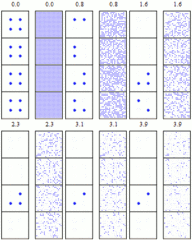 Half-life simulation

Advertise on WikiMD — 81,000+ full articles, ~900,000 total pages, ~250 million page views. Global reach, limited time promotional rates from $1/page/day. Learn more · View stats

Medical Disclaimer: WikiMD is for informational purposes only and is not a substitute for professional medical advice. Content may be inaccurate or outdated and should not be used for diagnosis or treatment. Always consult your healthcare provider for medical decisions. Verify information with trusted sources such as CDC.gov and NIH.gov. By using this site, you agree that WikiMD is not liable for any outcomes related to its content. See full disclaimer.
Credits:Most images are courtesy of Wikimedia commons, and templates, categories Wikipedia, licensed under CC BY SA or similar.
Translate page: - East Asian
中文,
日本,
한국어,
South Asian
हिन्दी,
தமிழ்,
తెలుగు,
Urdu,
ಕನ್ನಡ,
Southeast Asian
Indonesian,
Vietnamese,
Thai,
မြန်မာဘာသာ,
বাংলা
European
español,
Deutsch,
français,
Greek,
português do Brasil,
polski,
română,
русский,
Nederlands,
norsk,
svenska,
suomi,
Italian
Middle Eastern & African
عربى,
Turkish,
Persian,
Hebrew,
Afrikaans,
isiZulu,
Kiswahili,
Other
Bulgarian,
Hungarian,
Czech,
Swedish,
മലയാളം,
मराठी,
ਪੰਜਾਬੀ,
ગુજરાતી,
Portuguese,
Ukrainian

