DNA sequencing
DNA sequencing is the process of determining the precise order of nucleotides within a DNA molecule. It includes any method or technology that is used to determine the order of the four bases: adenine, guanine, cytosine, and thymine. The advent of rapid DNA sequencing methods has greatly accelerated biological and medical research and discovery.
History[edit]
The first DNA sequences were obtained in the early 1970s by academic researchers using laborious methods based on two-dimensional chromatography. Following the development of fluorescence-based sequencing methods with a more automated and much higher throughput, DNA sequencing has become a common method in biological research and medical testing.
Methods[edit]
There are several methods of DNA sequencing: the chain termination methods, the chemical method, and the pyrosequencing method. The most frequently used method today is called the dideoxy method or Sanger method, developed by Frederick Sanger in 1977.
Applications[edit]
DNA sequencing may be used to determine the sequence of individual genes, larger genetic regions (i.e., clusters of genes or operons), full chromosomes, or entire genomes. DNA sequencing is also the most efficient way to sequence RNA or proteins, via their conversion to cDNA.
See also[edit]
References[edit]

This WikiMD article can only be edited by registered and verified editors. You can log in or register.
DNA_sequencing[edit]
-
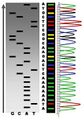 Radioactive Fluorescent Seq
 -
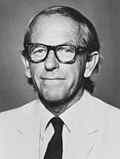 Frederick Sanger
 -
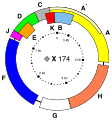 Genome map of the bacteriophage ΦX174 showing overlapping genes
 -
 History of sequencing technology
 -
 DNA Sequencing gDNA libraries
 -
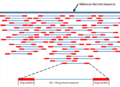 Mapping Reads
 -
 Illumina HiSeq 2500
 -
 Illumina NovaSeq 6000 flow cell
 -
 Illumina MiSeq sequencer
 -
 MGISEQ-2000RS
 -
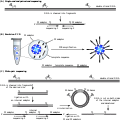 Library preparation for the SOLiD platform
 -
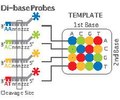 Two-base encoding scheme


Medical Disclaimer: WikiMD is for informational purposes only and is not a substitute for professional medical advice. Content may be inaccurate or outdated and should not be used for diagnosis or treatment. Always consult your healthcare provider for medical decisions. Verify information with trusted sources such as CDC.gov and NIH.gov. By using this site, you agree that WikiMD is not liable for any outcomes related to its content. See full disclaimer.
Credits:Most images are courtesy of Wikimedia commons, and templates, categories Wikipedia, licensed under CC BY SA or similar.
Translate page: - East Asian
中文,
日本,
한국어,
South Asian
हिन्दी,
தமிழ்,
తెలుగు,
Urdu,
ಕನ್ನಡ,
Southeast Asian
Indonesian,
Vietnamese,
Thai,
မြန်မာဘာသာ,
বাংলা
European
español,
Deutsch,
français,
Greek,
português do Brasil,
polski,
română,
русский,
Nederlands,
norsk,
svenska,
suomi,
Italian
Middle Eastern & African
عربى,
Turkish,
Persian,
Hebrew,
Afrikaans,
isiZulu,
Kiswahili,
Other
Bulgarian,
Hungarian,
Czech,
Swedish,
മലയാളം,
मराठी,
ਪੰਜਾਬੀ,
ગુજરાતી,
Portuguese,
Ukrainian

