Bulboid corpuscle
Bulboid corpuscle (also known as Krause end bulb or Krause corpuscle) is a type of mechanoreceptor, a sensory receptor, that is found in the human body. These corpuscles are named after the German anatomist Wilhelm Krause who first described them in the 19th century.
Etymology[edit]
The term "bulboid" is derived from the Latin word "bulbus" meaning "bulb", and the Greek word "eidos" meaning "form" or "shape". The term "corpuscle" comes from the Latin "corpusculum" meaning "small body". The term "Krause end bulb" is named after Wilhelm Krause, a German anatomist who first described these structures.
Structure and Function[edit]
Bulboid corpuscles are encapsulated unmyelinated nerve endings, which are nerve endings that lack a myelin sheath. They are found in the skin and mucous membranes and are believed to function as mechanoreceptors that respond to changes in pressure and vibration. They are particularly sensitive to thermal changes and may play a role in the detection of cold temperatures.
Clinical Significance[edit]
Changes in the function or number of bulboid corpuscles may be associated with certain medical conditions. For example, a decrease in the number of these corpuscles may be seen in neuropathy, a condition that affects the nerves. Additionally, an increase in the number of these corpuscles may be associated with conditions that cause inflammation or irritation of the skin or mucous membranes.
Related Terms[edit]
- Mechanoreceptor: A type of sensory receptor that responds to mechanical pressure or distortion.
- Unmyelinated nerve endings: Nerve endings that lack a myelin sheath, a protective covering that helps to speed up the transmission of nerve impulses.
- Neuropathy: A condition that affects the nerves, causing symptoms such as pain, tingling, numbness, or weakness.

This WikiMD article can only be edited by registered and verified editors. You can log in or register.
-
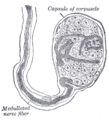 Bulboid corpuscle


Medical Disclaimer: WikiMD is for informational purposes only and is not a substitute for professional medical advice. Content may be inaccurate or outdated and should not be used for diagnosis or treatment. Always consult your healthcare provider for medical decisions. Verify information with trusted sources such as CDC.gov and NIH.gov. By using this site, you agree that WikiMD is not liable for any outcomes related to its content. See full disclaimer.
Credits:Most images are courtesy of Wikimedia commons, and templates, categories Wikipedia, licensed under CC BY SA or similar.
Translate page: - East Asian
中文,
日本,
한국어,
South Asian
हिन्दी,
தமிழ்,
తెలుగు,
Urdu,
ಕನ್ನಡ,
Southeast Asian
Indonesian,
Vietnamese,
Thai,
မြန်မာဘာသာ,
বাংলা
European
español,
Deutsch,
français,
Greek,
português do Brasil,
polski,
română,
русский,
Nederlands,
norsk,
svenska,
suomi,
Italian
Middle Eastern & African
عربى,
Turkish,
Persian,
Hebrew,
Afrikaans,
isiZulu,
Kiswahili,
Other
Bulgarian,
Hungarian,
Czech,
Swedish,
മലയാളം,
मराठी,
ਪੰਜਾਬੀ,
ગુજરાતી,
Portuguese,
Ukrainian

