Nucleic acid sequence
Nucleic acid sequence is a succession of letters that indicate the order of nucleotides forming alleles within a DNA (deoxyribonucleic acid) or RNA (ribonucleic acid) molecule. By convention, sequences are usually presented from the 5' end to the 3' end. For DNA, the letters A, C, G, and T each stand for a particular nucleotide – adenine, cytosine, guanine, and thymine respectively. For RNA, the letters A, C, G, and U each stand for adenine, cytosine, guanine, and uracil respectively.
Structure and Function[edit]
Nucleic acid sequences are vital in the storage and transmission of genetic information. They are composed of smaller units called nucleotides, which consist of a nucleobase, a five-carbon sugar, and at least one phosphate group. The sequence of these nucleotides determines the genetic information carried by the molecule.
Sequencing Techniques[edit]
There are several techniques used to determine the sequence of nucleic acids, including Sanger sequencing, next-generation sequencing, and pyrosequencing. These techniques have revolutionized the field of genomics and have been instrumental in the completion of the Human Genome Project.
Applications[edit]
Nucleic acid sequences have a wide range of applications in biological research, medicine, and biotechnology. They are used in genetic testing, forensic science, and in the development of new pharmaceuticals.
See Also[edit]
References[edit]

This WikiMD article can only be edited by registered and verified editors. You can log in or register.
-
 RNA chemical structure
 -
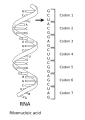 RNA codons
 -
 Kooditabel
 -
 DNA sequence
 -
 AMY1 gene


Sponsored Health Resource

W8MD Weight Loss, Sleep & MedSpa
Looking for physician-supervised weight loss, semaglutide, tirzepatide, or GLP-1 receptor agonist options? W8MD helps eligible patients in New York City, Brooklyn, New Jersey, Connecticut, Pennsylvania, Delaware, and greater Philadelphia with medical weight loss, sleep medicine, and long-term maintenance support.
GLP-1 specials: Affordable GLP-1 injections NYC and Philadelphia starting from $29.99/week and up for semaglutide with insurance accepted for qualifying visits, and $45/week and up for tirzepatide with insurance accepted for qualifying visits. Self-pay options start from $59.99/week and up for semaglutide and $69.99/week and up for tirzepatide.
Medical weight loss NYC | Affordable GLP-1 injections NYC | Budget GLP-1 weight loss shots Philadelphia | New Jersey medical weight loss | NYC medical weight loss | Philadelphia medical weight loss | Sleep clinic NYC | W8MD's Philadelphia GLP-1 doctor | Weight loss prescriptions NYC
Book a W8MD appointment · View GLP-1 specials
Paid promotional message. Eligibility, pricing, insurance coverage, medication availability, and results vary. Medical evaluation required.

Medical Disclaimer: WikiMD is for informational purposes only and is not a substitute for professional medical advice. Content may be inaccurate or outdated and should not be used for diagnosis or treatment. Always consult your healthcare provider for medical decisions. Verify information with trusted sources such as CDC.gov and NIH.gov. By using this site, you agree that WikiMD is not liable for any outcomes related to its content. See full disclaimer.
Credits:Most images are courtesy of Wikimedia commons, and templates, categories Wikipedia, licensed under CC BY SA or similar.
Translate page: - East Asian
中文,
日本,
한국어,
South Asian
हिन्दी,
தமிழ்,
తెలుగు,
Urdu,
ಕನ್ನಡ,
Southeast Asian
Indonesian,
Vietnamese,
Thai,
မြန်မာဘာသာ,
বাংলা
European
español,
Deutsch,
français,
Greek,
português do Brasil,
polski,
română,
русский,
Nederlands,
norsk,
svenska,
suomi,
Italian
Middle Eastern & African
عربى,
Turkish,
Persian,
Hebrew,
Afrikaans,
isiZulu,
Kiswahili,
Other
Bulgarian,
Hungarian,
Czech,
Swedish,
മലയാളം,
मराठी,
ਪੰਜਾਬੀ,
ગુજરાતી,
Portuguese,
Ukrainian

