Gastrotrich
Gastrotricha is a phylum of microscopic, worm-like, aquatic animals classified within the group of multicellular organisms known as Metazoa. Gastrotrichs are predominantly found in marine and freshwater environments, where they play a crucial role in the benthic community, contributing to the breakdown of organic matter and forming part of the diet of many larger organisms. This article provides an overview of the Gastrotricha, including their morphology, ecology, reproduction, and classification.
Morphology[edit]
Gastrotrichs are small animals, typically measuring between 0.06 to 4 mm in length. They have a transparent, elongated body that is divided into two distinct regions: a head and a trunk. The body is covered with cilia, which are hair-like structures that facilitate movement and feeding. Gastrotrichs possess a simple digestive system that includes a mouth, pharynx, intestine, and a terminal anus. Some species have adhesive tubes at the rear of their bodies, which they use to attach to substrates.
Ecology[edit]
Gastrotrichs inhabit a wide range of aquatic environments, including marine, brackish, and freshwater habitats. They are primarily benthic, living on or near the substrate. Gastrotrichs feed on microorganisms such as bacteria, algae, and protozoa, playing a significant role in the microbial loop by recycling nutrients. They are also preyed upon by various invertebrates and small fish, making them an integral part of aquatic food webs.
Reproduction[edit]
Gastrotrichs exhibit a variety of reproductive strategies, including hermaphroditism and parthenogenesis. Most freshwater species are parthenogenetic, meaning they can reproduce without fertilization, leading to rapid population growth under favorable conditions. Marine species tend to be dioecious, with separate male and female individuals. Fertilization is internal, and development is direct, with no larval stage. Gastrotrichs have a short lifespan, often only a few days to a few weeks.
Classification[edit]
The phylum Gastrotricha is divided into two orders: Macrodasyida and Chaetonotida. Macrodasyida are primarily marine and are characterized by their elongated bodies and the presence of adhesive tubes. Chaetonotida can be found in both marine and freshwater environments and are distinguished by their more compact body shape and lack of adhesive tubes.
Conservation[edit]
Gastrotrichs are considered to be of least concern from a conservation perspective due to their widespread distribution and high reproductive rates. However, like many microscopic aquatic organisms, they are susceptible to changes in water quality and habitat destruction, which can impact their populations.
Research and Importance[edit]
Despite their small size and seemingly simple organization, gastrotrichs are of significant interest to researchers studying the evolution of multicellular organisms, developmental biology, and aquatic ecosystems. Their sensitivity to environmental changes also makes them useful bioindicators for assessing water quality.

-
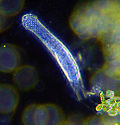 Gastrotrich
 -
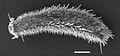 Thaumastoderma ramuliferum
 -
 Lepidodermella squamatum
 -
 Diplodasys rothei
 -
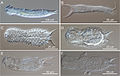 Gastrotricha (South Africa)
 -
 Thaumastodermatinae


.jpg)

Ad. Transform your health with W8MD Weight Loss, Sleep & MedSpa

Tired of being overweight?
Special offer:
Budget GLP-1 weight loss medications
- Semaglutide starting from $29.99/week and up with insurance for visit of $59.99 and up per week self pay.
- Tirzepatide starting from $45.00/week and up (dose dependent) or $69.99/week and up self pay
✔ Same-week appointments, evenings & weekends
Learn more:
- GLP-1 weight loss clinic NYC
- W8MD's NYC medical weight loss
- W8MD Philadelphia GLP-1 shots
- Philadelphia GLP-1 injections
- Affordable GLP-1 shots NYC
|
WikiMD Medical Encyclopedia |
Medical Disclaimer: WikiMD is for informational purposes only and is not a substitute for professional medical advice. Content may be inaccurate or outdated and should not be used for diagnosis or treatment. Always consult your healthcare provider for medical decisions. Verify information with trusted sources such as CDC.gov and NIH.gov. By using this site, you agree that WikiMD is not liable for any outcomes related to its content. See full disclaimer.
Credits:Most images are courtesy of Wikimedia commons, and templates, categories Wikipedia, licensed under CC BY SA or similar.
Translate this page: - East Asian
中文,
日本,
한국어,
South Asian
हिन्दी,
தமிழ்,
తెలుగు,
Urdu,
ಕನ್ನಡ,
Southeast Asian
Indonesian,
Vietnamese,
Thai,
မြန်မာဘာသာ,
বাংলা
European
español,
Deutsch,
français,
Greek,
português do Brasil,
polski,
română,
русский,
Nederlands,
norsk,
svenska,
suomi,
Italian
Middle Eastern & African
عربى,
Turkish,
Persian,
Hebrew,
Afrikaans,
isiZulu,
Kiswahili,
Other
Bulgarian,
Hungarian,
Czech,
Swedish,
മലയാളം,
मराठी,
ਪੰਜਾਬੀ,
ગુજરાતી,
Portuguese,
Ukrainian
