Gabapentinoid
Gabapentinoid is a class of drugs that includes two FDA-approved medications, gabapentin and pregabalin. These drugs are primarily used to treat neuropathic pain and epilepsy.
Overview[edit]
Gabapentinoids are analogs of the neurotransmitter gamma-aminobutyric acid (GABA). Despite this, they do not bind to the GABA receptors, but instead modulate the release of excitatory neurotransmitters.
Medical Uses[edit]
Gabapentinoids are used in the treatment of several medical conditions:
- Neuropathic pain: Gabapentinoids are effective in reducing pain and improving sleep in patients with neuropathic pain.
- Epilepsy: Both gabapentin and pregabalin are approved for the treatment of partial seizures.
- Fibromyalgia: Pregabalin is approved for the treatment of fibromyalgia in the United States.
Side Effects[edit]
Common side effects of gabapentinoids include dizziness, drowsiness, and peripheral edema. Serious side effects may include an increased risk of suicide, respiratory depression, and drug misuse.
Mechanism of Action[edit]
Gabapentinoids bind to the α2δ (alpha-2-delta) subunit of voltage-dependent calcium channels in the central nervous system. This reduces calcium influx at nerve terminals and subsequently reduces the release of excitatory neurotransmitters.
See Also[edit]

This WikiMD article can only be edited by registered and verified editors. You can log in or register.
-
 Gabapentin 2D structure
 -
 Gabapentinoid chemical structures
 -
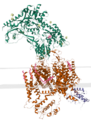 Calcium channel with gabapentin bound


Medical Disclaimer: WikiMD is for informational purposes only and is not a substitute for professional medical advice. Content may be inaccurate or outdated and should not be used for diagnosis or treatment. Always consult your healthcare provider for medical decisions. Verify information with trusted sources such as CDC.gov and NIH.gov. By using this site, you agree that WikiMD is not liable for any outcomes related to its content. See full disclaimer.
Credits:Most images are courtesy of Wikimedia commons, and templates, categories Wikipedia, licensed under CC BY SA or similar.
Translate page: - East Asian
中文,
日本,
한국어,
South Asian
हिन्दी,
தமிழ்,
తెలుగు,
Urdu,
ಕನ್ನಡ,
Southeast Asian
Indonesian,
Vietnamese,
Thai,
မြန်မာဘာသာ,
বাংলা
European
español,
Deutsch,
français,
Greek,
português do Brasil,
polski,
română,
русский,
Nederlands,
norsk,
svenska,
suomi,
Italian
Middle Eastern & African
عربى,
Turkish,
Persian,
Hebrew,
Afrikaans,
isiZulu,
Kiswahili,
Other
Bulgarian,
Hungarian,
Czech,
Swedish,
മലയാളം,
मराठी,
ਪੰਜਾਬੀ,
ગુજરાતી,
Portuguese,
Ukrainian

