G protein-coupled receptor
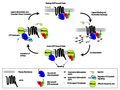
G protein-coupled receptors (GPCRs), also known as seven-(pass)-transmembrane domain receptors, 7TM receptors, heptahelical receptors, serpentine receptor, and G protein-linked receptors (GPLR), constitute a large protein family of receptors that detect molecules outside the cell and activate internal signal transduction pathways and, ultimately, cellular responses.
Structure[edit]
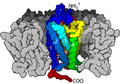
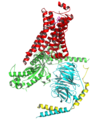
GPCRs are integral membrane proteins that possess seven transmembrane domains. The extracellular parts of the receptor can be glycosylated. These extracellular loops also contain two highly conserved cysteine residues which build disulfide bonds to stabilize the receptor structure. Some of the GPCRs also possess an extracellular N-terminus domain which binds the ligand, for example, the rhodopsin family of GPCRs.
Function[edit]
GPCRs are involved in a wide variety of physiological processes. Some examples of their physiological roles include:
- The visual sense: The photoreceptor cells in the retina possess the photoreceptor protein, which is a GPCR. The opsin in these proteins undergoes a conformational change when it absorbs a photon, leading to a series of events which ends in an electrical signal being sent to the brain.
- The gustatory sense (taste): GPCRs in taste cells mediate release of intracellular calcium, allowing the cell to release neurotransmitters into the synaptic cleft.
- The sense of smell: Receptors of the olfactory epithelium bind odorants, and, here again, use GPCRs to produce an electrical signal.
- Behavioral and mood regulation: Receptors in the mammalian brain bind several different neurotransmitters, including serotonin, dopamine, GABA, and glutamate.
- Regulation of immune system activity and inflammation: Chemokine receptors bind ligands that mediate intercellular communication between cells of the immune system. GPCRs are also involved in immune-modulation and directly involved in suppression of TLR-induced immune responses from T cells.
Classification[edit]
GPCRs are classified by the International Union of Basic and Clinical Pharmacology (IUPHAR) into several families, based on sequence homology:
- Class A (or 1) (Rhodopsin-like)
- Class B (or 2) (Secretin receptor family)
- Class C (or 3) (Metabotropic glutamate/pheromone)
- Class D (or 4) (Fungal mating pheromone receptors)
- Class E (or 5) (Cyclic AMP receptors)
- Class F (or 6) (Frizzled/Smoothened)
See also[edit]
- Adrenergic receptor
- Dopamine receptor
- Histamine receptor
- Serotonin receptor
- Metabotropic glutamate receptor
References[edit]
This GPCR-related article is a stub. You can help WikiMD by expanding it.
-
G protein-coupled receptor
-
 G protein-coupled receptor
 -
G protein-coupled receptor
-
 G protein-coupled receptor
 -
G protein-coupled receptor
-
G protein-coupled receptor
-
 G protein-coupled receptor
 -
 G protein-coupled receptor
 -
G protein-coupled receptor
-
G protein-coupled receptor
-
G protein-coupled receptor
-
G protein-coupled receptor


Medical Disclaimer: WikiMD is for informational purposes only and is not a substitute for professional medical advice. Content may be inaccurate or outdated and should not be used for diagnosis or treatment. Always consult your healthcare provider for medical decisions. Verify information with trusted sources such as CDC.gov and NIH.gov. By using this site, you agree that WikiMD is not liable for any outcomes related to its content. See full disclaimer.
Credits:Most images are courtesy of Wikimedia commons, and templates, categories Wikipedia, licensed under CC BY SA or similar.
Translate page: - East Asian
中文,
日本,
한국어,
South Asian
हिन्दी,
தமிழ்,
తెలుగు,
Urdu,
ಕನ್ನಡ,
Southeast Asian
Indonesian,
Vietnamese,
Thai,
မြန်မာဘာသာ,
বাংলা
European
español,
Deutsch,
français,
Greek,
português do Brasil,
polski,
română,
русский,
Nederlands,
norsk,
svenska,
suomi,
Italian
Middle Eastern & African
عربى,
Turkish,
Persian,
Hebrew,
Afrikaans,
isiZulu,
Kiswahili,
Other
Bulgarian,
Hungarian,
Czech,
Swedish,
മലയാളം,
मराठी,
ਪੰਜਾਬੀ,
ગુજરાતી,
Portuguese,
Ukrainian


