Fujimoto–Belleau reaction
Fujimoto–Belleau reaction is a chemical reaction named after the scientists who first described it, Hiroshi Fujimoto and Bernard Belleau, in the mid-20th century. This reaction involves the conversion of certain alkyl halides into amines through a process known as nucleophilic substitution. Specifically, the Fujimoto–Belleau reaction is notable for its application in the synthesis of tertiary amines from primary amines, using a secondary amine as a nucleophile. This reaction is an important method in the field of organic chemistry, particularly in the synthesis of pharmaceuticals and other nitrogen-containing compounds.
Mechanism[edit]
The mechanism of the Fujimoto–Belleau reaction involves several key steps. Initially, the primary amine reacts with a suitable alkylating agent, typically an alkyl halide, to form a secondary amine. This intermediate then undergoes further alkylation to produce a tertiary amine. The reaction conditions, such as the choice of solvent and temperature, play a crucial role in determining the yield and purity of the final product. The use of excess alkylating agent can drive the reaction towards the formation of the desired tertiary amine.
Applications[edit]
The Fujimoto–Belleau reaction has found widespread application in the synthesis of various organic compounds, particularly those with medicinal properties. Tertiary amines are a common structural motif in many pharmaceuticals, and the ability to synthesize these compounds efficiently is of great importance to the pharmaceutical industry. Additionally, this reaction is used in the preparation of agrochemicals, dyes, and other industrial chemicals.
Advantages and Limitations[edit]
One of the main advantages of the Fujimoto–Belleau reaction is its simplicity and efficiency in synthesizing tertiary amines. However, the reaction also has some limitations. The use of alkyl halides as alkylating agents can lead to the formation of quaternary ammonium salts as side products, which can complicate the purification process. Moreover, the reaction conditions need to be carefully controlled to avoid over-alkylation and the formation of unwanted by-products.
See Also[edit]
References[edit]
<references/>

-
 Fujimoto–Belleau reaction scheme
 -
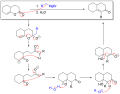 Fujimoto–Belleau reaction mechanism


Ad. Transform your health with W8MD Weight Loss, Sleep & MedSpa

Tired of being overweight?
Special offer:
Budget GLP-1 weight loss medications
- Semaglutide starting from $29.99/week and up with insurance for visit of $59.99 and up per week self pay.
- Tirzepatide starting from $45.00/week and up (dose dependent) or $69.99/week and up self pay
✔ Same-week appointments, evenings & weekends
Learn more:
- GLP-1 weight loss clinic NYC
- W8MD's NYC medical weight loss
- W8MD Philadelphia GLP-1 shots
- Philadelphia GLP-1 injections
- Affordable GLP-1 shots NYC
|
WikiMD Medical Encyclopedia |
Medical Disclaimer: WikiMD is for informational purposes only and is not a substitute for professional medical advice. Content may be inaccurate or outdated and should not be used for diagnosis or treatment. Always consult your healthcare provider for medical decisions. Verify information with trusted sources such as CDC.gov and NIH.gov. By using this site, you agree that WikiMD is not liable for any outcomes related to its content. See full disclaimer.
Credits:Most images are courtesy of Wikimedia commons, and templates, categories Wikipedia, licensed under CC BY SA or similar.
Translate this page: - East Asian
中文,
日本,
한국어,
South Asian
हिन्दी,
தமிழ்,
తెలుగు,
Urdu,
ಕನ್ನಡ,
Southeast Asian
Indonesian,
Vietnamese,
Thai,
မြန်မာဘာသာ,
বাংলা
European
español,
Deutsch,
français,
Greek,
português do Brasil,
polski,
română,
русский,
Nederlands,
norsk,
svenska,
suomi,
Italian
Middle Eastern & African
عربى,
Turkish,
Persian,
Hebrew,
Afrikaans,
isiZulu,
Kiswahili,
Other
Bulgarian,
Hungarian,
Czech,
Swedish,
മലയാളം,
मराठी,
ਪੰਜਾਬੀ,
ગુજરાતી,
Portuguese,
Ukrainian
