Flesh fly
Flesh fly is a common name applied to various species of flies in the family Sarcophagidae. These flies are found worldwide and are known for their role in decomposition and as vectors for certain diseases.
Description[edit]
Flesh flies are typically gray in color and have a checkerboard pattern on their abdomen. They are larger than most other types of flies, with some species reaching up to 15 mm in length. The larvae, or maggots, are creamy white and can be up to 20 mm long.
Behavior[edit]
Flesh flies are scavengers and are attracted to decaying organic matter, where they lay their eggs or larvae. Unlike most flies, which lay eggs, many species of flesh flies give birth to live larvae. These larvae immediately begin feeding on the decaying matter, aiding in the process of decomposition.
Role in Ecosystem[edit]
Flesh flies play a crucial role in the ecosystem by helping to break down dead animals and other organic matter. This process helps to recycle nutrients back into the soil. However, because they are attracted to decaying matter, they can also be a nuisance in populated areas, especially during the warmer months.
Disease Transmission[edit]
Flesh flies can carry and transmit various diseases, including leprosy and intestinal parasites. They can also cause myiasis, a condition where the fly larvae infest and feed on living tissue.
Control[edit]
Control of flesh flies typically involves sanitation measures to remove potential breeding sites. Insecticides can also be used, but their effectiveness is often limited due to the fly's life cycle and behavior.
See Also[edit]
 | This insect-related article is a stub. You can help WikiMD by expanding the page. |
-
 Flesh fly
 -
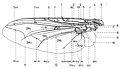 Nervation of Sarcophagidae
 -
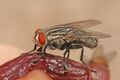 Sarcophaga nodosa
 -
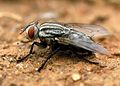 Sarcophagid sal
 -
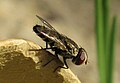 Craticulina showing arista, kleptoparasite of Philanthus


.jpg)
Sponsored Health Resource

W8MD Weight Loss, Sleep & MedSpa
Looking for physician-supervised weight loss, semaglutide, tirzepatide, or GLP-1 receptor agonist options? W8MD helps eligible patients in New York City, Brooklyn, New Jersey, Connecticut, Pennsylvania, Delaware, and greater Philadelphia with medical weight loss, sleep medicine, and long-term maintenance support.
GLP-1 specials: Affordable GLP-1 injections NYC and Philadelphia starting from $29.99/week and up for semaglutide with insurance accepted for qualifying visits, and $45/week and up for tirzepatide with insurance accepted for qualifying visits. Self-pay options start from $59.99/week and up for semaglutide and $69.99/week and up for tirzepatide.
- Medical weight loss NYC
- Affordable GLP-1 injections NYC
- Budget GLP-1 weight loss shots Philadelphia
- New Jersey medical weight loss
- NYC medical weight loss blog
- Philadelphia weight loss blog
- Sleep medicine and sleep apnea services
- W8MD MedSpa and wellness
Book a W8MD appointment · View GLP-1 specials
Paid promotional message. Eligibility, pricing, insurance coverage, medication availability, and results vary. Medical evaluation required.

Medical Disclaimer: WikiMD is for informational purposes only and is not a substitute for professional medical advice. Content may be inaccurate or outdated and should not be used for diagnosis or treatment. Always consult your healthcare provider for medical decisions. Verify information with trusted sources such as CDC.gov and NIH.gov. By using this site, you agree that WikiMD is not liable for any outcomes related to its content. See full disclaimer.
Credits:Most images are courtesy of Wikimedia commons, and templates, categories Wikipedia, licensed under CC BY SA or similar.
Translate page: - East Asian
中文,
日本,
한국어,
South Asian
हिन्दी,
தமிழ்,
తెలుగు,
Urdu,
ಕನ್ನಡ,
Southeast Asian
Indonesian,
Vietnamese,
Thai,
မြန်မာဘာသာ,
বাংলা
European
español,
Deutsch,
français,
Greek,
português do Brasil,
polski,
română,
русский,
Nederlands,
norsk,
svenska,
suomi,
Italian
Middle Eastern & African
عربى,
Turkish,
Persian,
Hebrew,
Afrikaans,
isiZulu,
Kiswahili,
Other
Bulgarian,
Hungarian,
Czech,
Swedish,
മലയാളം,
मराठी,
ਪੰਜਾਬੀ,
ગુજરાતી,
Portuguese,
Ukrainian

