Fibrillin
Fibrillin is a glycoprotein, which is essential for the formation of elastic fibers found in connective tissue. Fibrillin is secreted into the extracellular matrix by fibroblasts and becomes incorporated into the insoluble microfibrils, which appear to provide a scaffold for deposition of elastin.
Structure[edit]
Fibrillin is a large, extracellular matrix glycoprotein with a multidomain structure. It is composed of three types of repeating modules: epidermal growth factor-like (EGF-like) modules, transforming growth factor beta binding protein-like (TB) modules, and hybrid modules. The EGF-like modules contain six conserved cysteine residues, but unlike many EGF-like modules, most of these do not bind calcium.
Function[edit]
Fibrillin is a major building block of microfibrils, which provide force-bearing structural support in elastic and nonelastic tissues. Fibrillin microfibrils provide long-term force bearing structural support in elastic and nonelastic tissues. Fibrillin binds calcium and is coded by the FBN1 gene.
Clinical significance[edit]
Mutations in the FBN1 gene are associated with Marfan syndrome, Weill-Marchesani syndrome, and acromicric dysplasia. These are all heritable disorders affecting connective tissue.
See also[edit]
References[edit]
External links[edit]
- Fibrillin at WikiMD

This WikiMD article can only be edited by registered and verified editors. You can log in or register.
-
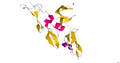 2W86 (Fibrillin)
.png)

Medical Disclaimer: WikiMD is for informational purposes only and is not a substitute for professional medical advice. Content may be inaccurate or outdated and should not be used for diagnosis or treatment. Always consult your healthcare provider for medical decisions. Verify information with trusted sources such as CDC.gov and NIH.gov. By using this site, you agree that WikiMD is not liable for any outcomes related to its content. See full disclaimer.
Credits:Most images are courtesy of Wikimedia commons, and templates, categories Wikipedia, licensed under CC BY SA or similar.
Translate page: - East Asian
中文,
日本,
한국어,
South Asian
हिन्दी,
தமிழ்,
తెలుగు,
Urdu,
ಕನ್ನಡ,
Southeast Asian
Indonesian,
Vietnamese,
Thai,
မြန်မာဘာသာ,
বাংলা
European
español,
Deutsch,
français,
Greek,
português do Brasil,
polski,
română,
русский,
Nederlands,
norsk,
svenska,
suomi,
Italian
Middle Eastern & African
عربى,
Turkish,
Persian,
Hebrew,
Afrikaans,
isiZulu,
Kiswahili,
Other
Bulgarian,
Hungarian,
Czech,
Swedish,
മലയാളം,
मराठी,
ਪੰਜਾਬੀ,
ગુજરાતી,
Portuguese,
Ukrainian

