Endoderm
Endoderm is one of the three primary germ layers in the very early embryo. The other two layers are the ectoderm (outside layer) and mesoderm (middle layer), with the endoderm being the innermost layer. Cells migrating inward along the archenteron form the inner layer of the gastrula, which develops into the endoderm.
The endoderm consists at first of flattened cells, which subsequently become columnar. It forms the epithelial lining of multiple systems.
Development[edit]
The endoderm produces tissue within the lungs, thyroid, and pancreas. The endoderm not only creates a number of tissues, but it also forms the linings of many systems. During the development of the embryo, some cells differentiate from the endoderm and create organs. This process is called organogenesis.
Function[edit]
The endoderm serves as the lining of the gastrointestinal tract and its associated structures. It also forms vital parts of the body's major organ systems, including the respiratory system, digestive system, and urinary system.
Clinical significance[edit]
Defects in the formation of the endoderm or in the organs it forms can lead to a number of medical conditions. For example, cystic fibrosis is a condition that affects organs that develop from the endoderm, such as the lungs and pancreas.
See also[edit]
References[edit]

This WikiMD article can only be edited by registered and verified editors. You can log in or register.
-
 Embryonic origin of endoderm
 -
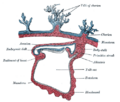 Gray's Anatomy illustration 21
 -
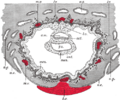 Gray's Anatomy illustration 32


Medical Disclaimer: WikiMD is for informational purposes only and is not a substitute for professional medical advice. Content may be inaccurate or outdated and should not be used for diagnosis or treatment. Always consult your healthcare provider for medical decisions. Verify information with trusted sources such as CDC.gov and NIH.gov. By using this site, you agree that WikiMD is not liable for any outcomes related to its content. See full disclaimer.
Credits:Most images are courtesy of Wikimedia commons, and templates, categories Wikipedia, licensed under CC BY SA or similar.
Translate page: - East Asian
中文,
日本,
한국어,
South Asian
हिन्दी,
தமிழ்,
తెలుగు,
Urdu,
ಕನ್ನಡ,
Southeast Asian
Indonesian,
Vietnamese,
Thai,
မြန်မာဘာသာ,
বাংলা
European
español,
Deutsch,
français,
Greek,
português do Brasil,
polski,
română,
русский,
Nederlands,
norsk,
svenska,
suomi,
Italian
Middle Eastern & African
عربى,
Turkish,
Persian,
Hebrew,
Afrikaans,
isiZulu,
Kiswahili,
Other
Bulgarian,
Hungarian,
Czech,
Swedish,
മലയാളം,
मराठी,
ਪੰਜਾਬੀ,
ગુજરાતી,
Portuguese,
Ukrainian

