Endorphins
Endorphins are endogenous neuropeptides, produced within the central nervous system (CNS) and the pituitary gland, which interact with opioid receptors to induce analgesia, or pain relief[1].
Endorphin Production[edit]
The term "endorphin" is a portmanteau of "endogenous" and "morphine," signifying morphine-like substances originating from within the body. The production of endorphins is triggered by various stimuli, including stress, fear, pain, and rigorous exercise.
Endorphin Types and Function[edit]
There are several types of endorphins, with beta-endorphins being the most potent. Produced in response to pain or stress, beta-endorphins bind to and activate the body's opioid receptors, much like morphine or other opioid pain relievers, but without the risk of addiction or dependence.
Mechanism of Action[edit]
The analgesic effect of endorphins is achieved when they bind to the body's opioid receptors, primarily the mu-opioid receptor, thereby inhibiting the transmission of pain signals. They also act to modulate the release of certain neurotransmitters, further influencing the perception of pain[2].
Endorphins and Exercise[edit]
The "runner's high," a feeling of euphoria experienced after prolonged exercise, is often attributed to the release of endorphins. Although the specific mechanisms and implications are still a subject of research, it's generally accepted that endorphins contribute to the improved mood and sensations of wellbeing that often follow vigorous physical activity[3].
Clinical Significance[edit]
A greater understanding of endorphins and their role in pain modulation is crucial for advancing pain management strategies. Harnessing the body's endorphin system could potentially lead to the development of new analgesic drugs that offer the pain-relieving benefits of opioids without the associated risks.
References[edit]
- ↑ Stein, James."Endorphins and Pain Relief".Molecular Pain.2011;7(1)
- 29–42.doi:10.1186/1744-8069-7-29.Full text.
- ↑ Peng, Hsien-Yu."Endorphins, enkephalins, and their receptor in pain modulation".The Chinese Journal of Physiology.1991;34(3)
- 119–130.Full text.
- ↑ Meeusen, Romain."Exercise, endorphins, and the stress response".The Journal of Experimental Biology.2008;209(5)
- 236–242.doi:10.1242/jeb.01529.Full text.

This WikiMD article can only be edited by registered and verified editors. You can log in or register.
Endorphins[edit]
-
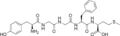 Met-enkephalin structure
 -
 A sailor exercising
 -
 Cocoa spelled out in cocoa powder

.jpg)


Medical Disclaimer: WikiMD is for informational purposes only and is not a substitute for professional medical advice. Content may be inaccurate or outdated and should not be used for diagnosis or treatment. Always consult your healthcare provider for medical decisions. Verify information with trusted sources such as CDC.gov and NIH.gov. By using this site, you agree that WikiMD is not liable for any outcomes related to its content. See full disclaimer.
Credits:Most images are courtesy of Wikimedia commons, and templates, categories Wikipedia, licensed under CC BY SA or similar.
Translate page: - East Asian
中文,
日本,
한국어,
South Asian
हिन्दी,
தமிழ்,
తెలుగు,
Urdu,
ಕನ್ನಡ,
Southeast Asian
Indonesian,
Vietnamese,
Thai,
မြန်မာဘာသာ,
বাংলা
European
español,
Deutsch,
français,
Greek,
português do Brasil,
polski,
română,
русский,
Nederlands,
norsk,
svenska,
suomi,
Italian
Middle Eastern & African
عربى,
Turkish,
Persian,
Hebrew,
Afrikaans,
isiZulu,
Kiswahili,
Other
Bulgarian,
Hungarian,
Czech,
Swedish,
മലയാളം,
मराठी,
ਪੰਜਾਬੀ,
ગુજરાતી,
Portuguese,
Ukrainian

