Efferent nerve fiber
Efferent nerve fibers are a crucial component of the nervous system, responsible for conveying motor commands from the central nervous system (CNS) to various parts of the body. These fibers are the pathways through which the brain and spinal cord send signals to muscles, glands, and other organs to initiate actions or responses. The term "efferent" comes from the Latin word "effere," meaning to carry away or out, which is a fitting description of their function in the body.
Overview[edit]
Efferent nerve fibers are part of the peripheral nervous system (PNS) and can be contrasted with afferent nerve fibers, which carry sensory information from the body back to the CNS. Together, these two types of fibers form the communication network that allows the body to respond and adapt to its environment.
Efferent fibers can be further divided into two main categories based on the type of signals they carry and their target organs: the somatic nervous system and the autonomic nervous system.
Somatic Nervous System[edit]
The somatic nervous system (SNS) controls voluntary movements of the body by innervating skeletal muscles. The efferent fibers in the SNS are responsible for transmitting motor commands from the CNS to these muscles, enabling conscious movement and reflex responses.
Autonomic Nervous System[edit]
The autonomic nervous system (ANS) regulates involuntary body functions, such as heart rate, digestion, and respiratory rate. It is subdivided into the sympathetic nervous system and the parasympathetic nervous system, each of which has a distinct set of efferent fibers that innervate various internal organs, glands, and smooth muscles, often with opposing effects to maintain homeostasis.
Function[edit]
The primary function of efferent nerve fibers is to transmit motor commands from the CNS to the effector organs. This process begins in the brain or spinal cord, where a motor signal is generated. The signal travels along the efferent fiber, exiting the CNS and reaching the target organ, where it triggers a specific response, such as muscle contraction or gland secretion.
Structure[edit]
Efferent nerve fibers vary in structure depending on their function and the type of signal they carry. Generally, these fibers are characterized by their myelination. Myelinated fibers have a sheath of myelin, which insulates the nerve and allows for faster signal transmission. Many efferent fibers, especially those in the SNS, are myelinated. However, some fibers in the ANS are unmyelinated, leading to slower signal transmission but allowing for a broader distribution of the signal.
Clinical Significance[edit]
Damage or disease affecting efferent nerve fibers can lead to a range of neurological conditions, depending on the location and extent of the damage. Such conditions may include motor neuron disease, peripheral neuropathy, and various forms of paralysis. Understanding the role and function of efferent fibers is crucial for diagnosing and treating these conditions.
See Also[edit]
-
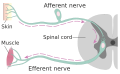 Diagram showing afferent and efferent neurons
 -
Illustration of a motoneuron


Medical Disclaimer: WikiMD is for informational purposes only and is not a substitute for professional medical advice. Content may be inaccurate or outdated and should not be used for diagnosis or treatment. Always consult your healthcare provider for medical decisions. Verify information with trusted sources such as CDC.gov and NIH.gov. By using this site, you agree that WikiMD is not liable for any outcomes related to its content. See full disclaimer.
Credits:Most images are courtesy of Wikimedia commons, and templates, categories Wikipedia, licensed under CC BY SA or similar.
Translate page: - East Asian
中文,
日本,
한국어,
South Asian
हिन्दी,
தமிழ்,
తెలుగు,
Urdu,
ಕನ್ನಡ,
Southeast Asian
Indonesian,
Vietnamese,
Thai,
မြန်မာဘာသာ,
বাংলা
European
español,
Deutsch,
français,
Greek,
português do Brasil,
polski,
română,
русский,
Nederlands,
norsk,
svenska,
suomi,
Italian
Middle Eastern & African
عربى,
Turkish,
Persian,
Hebrew,
Afrikaans,
isiZulu,
Kiswahili,
Other
Bulgarian,
Hungarian,
Czech,
Swedish,
മലയാളം,
मराठी,
ਪੰਜਾਬੀ,
ગુજરાતી,
Portuguese,
Ukrainian


