Millipede
Millipede is a group of arthropods that are characterized by having two pairs of jointed legs on most body segments. They are known for their elongated cylindrical bodies and are part of the class Diplopoda.
Anatomy and physiology[edit]
Millipedes are typically brown, moving with a wave-like motion, and are detritivores, eating decaying leaves and other dead plant matter. Some species can secrete a toxic liquid, which can be harmful to predators and cause minor skin irritation in humans.
Body[edit]
The body of a millipede is divided into many segments, with most segments having two pairs of legs. The head is rounded and bears a pair of antennae. The body is protected by an exoskeleton, which must be periodically shed and re-grown as the millipede grows in size.
Legs[edit]
Each segment of a millipede's body (except for the first three) bears two pairs of legs. The number of leg-bearing segments varies widely, from 11 to over 100, depending on the species.
Reproduction[edit]
Millipedes reproduce sexually, with males depositing a spermatophore for the female to take up. In some species, the male has modified legs called gonopods, which are used to transfer the spermatophore to the female.
Behavior and ecology[edit]
Millipedes are generally slow-moving detritivores, eating decaying leaves and other dead plant matter. They can be found in a variety of habitats where decaying plant material is abundant, such as forests, savannas, and grasslands.
Human interaction[edit]
While millipedes are harmless and non-aggressive towards humans, some species can secrete a toxic liquid which can cause skin irritation. They are often considered pests in greenhouses and gardens where they can cause damage to seedlings.
Taxonomy[edit]
Millipedes belong to the class Diplopoda, which is divided into sixteen orders and approximately 140 families. There are an estimated 12,000 species of millipedes worldwide.
See also[edit]
References[edit]
<references />
 | |
|---|---|
 |
 |
| This medical article is a stub. You can help Wikipedia by adding missing information. |
Millipede[edit]
-
 Millipede collage
 -
 Millipede order species comparison
 -
 Octoglena sierra (Family Polyzoniidae)
 -
 Anadenobolus monilicornis
 -
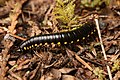 Harpaphe haydeniana
 -
 Pauropus huxleyi
 -
 Millipede centipede side-by-side
 -
 Millipede body types
 -
 Millipede anterior anatomy
 -
 Paranota comparison
 -
 Female Illacme plenipes with 618 legs
 -
 Mating millipedes


_(3405605943).jpg)


_with_618_legs_-_ZooKeys-241-077-SP-6-top.jpg)

Ad. Transform your health with W8MD Weight Loss, Sleep & MedSpa

Tired of being overweight?
Special offer:
Budget GLP-1 weight loss medications
- Semaglutide starting from $29.99/week and up with insurance for visit of $59.99 and up per week self pay.
- Tirzepatide starting from $45.00/week and up (dose dependent) or $69.99/week and up self pay
✔ Same-week appointments, evenings & weekends ✔ Tele visits available with certain limitations Learn more:
- GLP-1 weight loss clinic NYC
- W8MD's NYC medical weight loss
- W8MD Philadelphia GLP-1 shots
- Philadelphia GLP-1 injections
- Affordable GLP-1 shots NYC
- Budget GLP-1 shots
|
WikiMD Medical Encyclopedia |
Medical Disclaimer: WikiMD is for informational purposes only and is not a substitute for professional medical advice. Content may be inaccurate or outdated and should not be used for diagnosis or treatment. Always consult your healthcare provider for medical decisions. Verify information with trusted sources such as CDC.gov and NIH.gov. By using this site, you agree that WikiMD is not liable for any outcomes related to its content. See full disclaimer.
Credits:Most images are courtesy of Wikimedia commons, and templates, categories Wikipedia, licensed under CC BY SA or similar.
Translate this page: - East Asian
中文,
日本,
한국어,
South Asian
हिन्दी,
தமிழ்,
తెలుగు,
Urdu,
ಕನ್ನಡ,
Southeast Asian
Indonesian,
Vietnamese,
Thai,
မြန်မာဘာသာ,
বাংলা
European
español,
Deutsch,
français,
Greek,
português do Brasil,
polski,
română,
русский,
Nederlands,
norsk,
svenska,
suomi,
Italian
Middle Eastern & African
عربى,
Turkish,
Persian,
Hebrew,
Afrikaans,
isiZulu,
Kiswahili,
Other
Bulgarian,
Hungarian,
Czech,
Swedish,
മലയാളം,
मराठी,
ਪੰਜਾਬੀ,
ગુજરાતી,
Portuguese,
Ukrainian
