Longevity
Longevity refers to the duration of life of an organism or a group of organisms. It is often used in the context of human life span, but it can also be applied to other organisms. The study of longevity is part of the field of gerontology.
Factors Influencing Longevity[edit]
Several factors can influence longevity, including genetics, lifestyle, environment, and medical care.
Genetics[edit]
Genetics plays a significant role in determining an individual's potential lifespan. Certain genes, known as longevity genes, are associated with long life spans in various organisms.
Lifestyle[edit]
Lifestyle choices, such as diet, exercise, and avoidance of harmful habits like smoking, can also significantly influence longevity. A healthy lifestyle can help to prevent chronic diseases and improve quality of life.
Environment[edit]
The environment in which an individual lives can also impact their longevity. Factors such as air and water quality, access to medical care, and social support can all influence lifespan.
Medical Care[edit]
Access to quality medical care can also significantly impact an individual's longevity. Preventive healthcare, including regular check-ups and screenings, can help to detect and treat diseases early, potentially extending life span.
Longevity in Different Species[edit]
Longevity varies widely among different species. Some organisms, like the bowhead whale and the giant tortoise, are known for their exceptionally long lifespans. Others, like the mayfly, have very short lifespans.
Human Longevity[edit]
Human longevity has increased significantly over the past century, largely due to improvements in medical care, nutrition, and sanitation. The oldest verified person on record lived to be 122 years and 164 days old.
See Also[edit]

This WikiMD article can only be edited by registered and verified editors. You can log in or register.
-
 Comparison of male and female life expectancy
 -
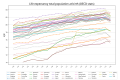 Life Expectancy in OECD
 -
Longevity
-
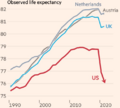 Life expectancy post-COVID


Medical Disclaimer: WikiMD is for informational purposes only and is not a substitute for professional medical advice. Content may be inaccurate or outdated and should not be used for diagnosis or treatment. Always consult your healthcare provider for medical decisions. Verify information with trusted sources such as CDC.gov and NIH.gov. By using this site, you agree that WikiMD is not liable for any outcomes related to its content. See full disclaimer.
Credits:Most images are courtesy of Wikimedia commons, and templates, categories Wikipedia, licensed under CC BY SA or similar.
Translate page: - East Asian
中文,
日本,
한국어,
South Asian
हिन्दी,
தமிழ்,
తెలుగు,
Urdu,
ಕನ್ನಡ,
Southeast Asian
Indonesian,
Vietnamese,
Thai,
မြန်မာဘာသာ,
বাংলা
European
español,
Deutsch,
français,
Greek,
português do Brasil,
polski,
română,
русский,
Nederlands,
norsk,
svenska,
suomi,
Italian
Middle Eastern & African
عربى,
Turkish,
Persian,
Hebrew,
Afrikaans,
isiZulu,
Kiswahili,
Other
Bulgarian,
Hungarian,
Czech,
Swedish,
മലയാളം,
मराठी,
ਪੰਜਾਬੀ,
ગુજરાતી,
Portuguese,
Ukrainian


