Decomposer
Decomposer is a term used in the field of ecology to refer to organisms that break down dead or decaying organisms, and in doing so, carry out the natural process of decomposition. Decomposers are heterotrophic organisms, meaning they use organic substrates to get their energy, carbon and nutrients for growth and development. This includes bacteria, fungi, and invertebrates.
Role in Ecosystem[edit]
Decomposers play a crucial role in the ecosystem. They help in the recycling of nutrients by breaking down dead or decaying organisms. These nutrients are then returned to the soil, where they can be used by plants to grow. Without decomposers, these nutrients would remain locked up in the dead organisms, making them unavailable to other living organisms.
Types of Decomposers[edit]
There are two main types of decomposers: bacteria and fungi. Bacteria are single-celled organisms that reproduce by binary fission. They are found in every habitat on Earth, including soil, water, and even the human body. Fungi are multicellular organisms that reproduce by producing spores. They are found in many different habitats, including soil, water, and on the bodies of other organisms.
Bacteria[edit]
Bacteria are the most common type of decomposer. They are capable of breaking down a wide range of organic materials, including cellulose and lignin, which are difficult for many other organisms to digest. Some bacteria are also capable of fixing nitrogen, which is an important nutrient for plant growth.
Fungi[edit]
Fungi are another important group of decomposers. They are particularly good at breaking down complex organic materials, such as lignin and cellulose, which are found in the cell walls of plants. Fungi also play a crucial role in the decomposition of wood.
Decomposition Process[edit]
The decomposition process involves several stages. First, the organic material is broken down into smaller pieces by detritivores, such as earthworms and beetles. Next, the smaller pieces are further broken down by decomposers, such as bacteria and fungi. Finally, the decomposed material is returned to the soil, where it can be used by plants to grow.
See Also[edit]

This WikiMD article can only be edited by registered and verified editors. You can log in or register.
Decomposer gallery[edit]
-
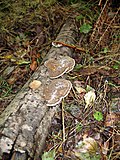 Fungi on fallen Birch Branch

Sponsored Health Resource

W8MD Weight Loss, Sleep & MedSpa
Looking for physician-supervised weight loss, semaglutide, tirzepatide, or GLP-1 receptor agonist options? W8MD helps eligible patients in New York City, Brooklyn, New Jersey, Connecticut, Pennsylvania, Delaware, and greater Philadelphia with medical weight loss, sleep medicine, and long-term maintenance support.
GLP-1 specials: Affordable GLP-1 injections NYC and Philadelphia starting from $29.99/week and up for semaglutide with insurance accepted for qualifying visits, and $45/week and up for tirzepatide with insurance accepted for qualifying visits. Self-pay options start from $59.99/week and up for semaglutide and $69.99/week and up for tirzepatide.
- Medical weight loss NYC
- Affordable GLP-1 injections NYC
- Budget GLP-1 weight loss shots Philadelphia
- New Jersey medical weight loss
- NYC medical weight loss blog
- Philadelphia weight loss blog
- Sleep medicine and sleep apnea services
- W8MD MedSpa and wellness
Book a W8MD appointment · View GLP-1 specials
Paid promotional message. Eligibility, pricing, insurance coverage, medication availability, and results vary. Medical evaluation required.

Medical Disclaimer: WikiMD is for informational purposes only and is not a substitute for professional medical advice. Content may be inaccurate or outdated and should not be used for diagnosis or treatment. Always consult your healthcare provider for medical decisions. Verify information with trusted sources such as CDC.gov and NIH.gov. By using this site, you agree that WikiMD is not liable for any outcomes related to its content. See full disclaimer.
Credits:Most images are courtesy of Wikimedia commons, and templates, categories Wikipedia, licensed under CC BY SA or similar.
Translate page: - East Asian
中文,
日本,
한국어,
South Asian
हिन्दी,
தமிழ்,
తెలుగు,
Urdu,
ಕನ್ನಡ,
Southeast Asian
Indonesian,
Vietnamese,
Thai,
မြန်မာဘာသာ,
বাংলা
European
español,
Deutsch,
français,
Greek,
português do Brasil,
polski,
română,
русский,
Nederlands,
norsk,
svenska,
suomi,
Italian
Middle Eastern & African
عربى,
Turkish,
Persian,
Hebrew,
Afrikaans,
isiZulu,
Kiswahili,
Other
Bulgarian,
Hungarian,
Czech,
Swedish,
മലയാളം,
मराठी,
ਪੰਜਾਬੀ,
ગુજરાતી,
Portuguese,
Ukrainian

