Database
Database is a structured set of data. So, a computer database is a structured set of data stored in a computer or server. The structure is achieved by organizing the data according to a database model. The model in most common use today is the relational model. Other models such as the hierarchical model and the network model use a more explicit representation of relationships.
Overview[edit]
A database is an organized collection of data stored and accessed electronically. Databases are more complex than spreadsheets as they can handle larger amounts of data and more users. They are designed to manage, store, and retrieve information. They are essential for managing the large amounts of data generated by businesses, governments, and scientific research.
Types of Databases[edit]
There are several types of databases, including:
- Relational database - This type of database defines database relationships in terms of tables. It is also the most widely used database model.
- Object-oriented database - This type of database combines the features of both the relational model and the object-oriented programming paradigm.
- Hierarchical database - This type of database organizes data in a tree-like structure.
- Network database - This type of database allows each record to have multiple parent and child records, which, when visualized, resemble a net-like structure.
Database Management Systems[edit]
A Database Management System (DBMS) is software that interacts with the user, applications, and the database itself to capture and analyze data. A general-purpose DBMS allows the definition, creation, querying, update, and administration of databases.
See Also[edit]
References[edit]

This WikiMD article can only be edited by registered and verified editors. You can log in or register.
-
 DVD Rental Query
 -
 Codasyl Database Model
 -
 Relational Key
 -
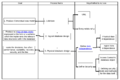 Process of Database Design
 -
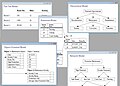 Database Models
 -
 Traditional View of Data


Medical Disclaimer: WikiMD is for informational purposes only and is not a substitute for professional medical advice. Content may be inaccurate or outdated and should not be used for diagnosis or treatment. Always consult your healthcare provider for medical decisions. Verify information with trusted sources such as CDC.gov and NIH.gov. By using this site, you agree that WikiMD is not liable for any outcomes related to its content. See full disclaimer.
Credits:Most images are courtesy of Wikimedia commons, and templates, categories Wikipedia, licensed under CC BY SA or similar.
Translate page: - East Asian
中文,
日本,
한국어,
South Asian
हिन्दी,
தமிழ்,
తెలుగు,
Urdu,
ಕನ್ನಡ,
Southeast Asian
Indonesian,
Vietnamese,
Thai,
မြန်မာဘာသာ,
বাংলা
European
español,
Deutsch,
français,
Greek,
português do Brasil,
polski,
română,
русский,
Nederlands,
norsk,
svenska,
suomi,
Italian
Middle Eastern & African
عربى,
Turkish,
Persian,
Hebrew,
Afrikaans,
isiZulu,
Kiswahili,
Other
Bulgarian,
Hungarian,
Czech,
Swedish,
മലയാളം,
मराठी,
ਪੰਜਾਬੀ,
ગુજરાતી,
Portuguese,
Ukrainian

