Cyclotron
Cyclotron is a type of particle accelerator invented by Ernest O. Lawrence in 1932 in which charged particles accelerate outwards from the center along a spiral path. The particles are held to a spiral trajectory by a static magnetic field and accelerated by a rapidly varying (radio frequency) electric field.
History[edit]
The cyclotron was invented and patented by Ernest O. Lawrence of the University of California, Berkeley, where it was first operated in 1932. With Stanley Livingston as his graduate student, Lawrence constructed the first cyclotron at Berkeley. Livingston went on to head the project when Lawrence moved on to other projects.
Operation[edit]
In a cyclotron, a high-frequency alternating voltage applied across the "D" electrodes (also called "dees") alternately attracts and repels charged particles. The particles, injected near the center of the magnetic field, increase in speed and move in larger and larger orbits until they hit a target at the perimeter of the vacuum chamber, or leave the cyclotron through an exit port.
Applications[edit]
Cyclotrons have many practical applications. In medicine, cyclotrons often produce radioisotopes for radiopharmaceuticals that are used in PET scans. Cyclotrons can also be used in particle therapy to treat cancer, where the particles are used to bombard diseased tissue.
See also[edit]
References[edit]

This WikiMD article can only be edited by registered and verified editors. You can log in or register.
-
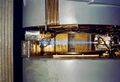 Cyclotron with glowing beam
 -
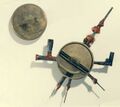 4-inch cyclotron
 -
 Berkeley 60-inch cyclotron
 -
 Cyclotron diagram
 -
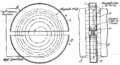 Cyclotron patent
 -
 Lawrence 27 inch cyclotron dees 1935
 -
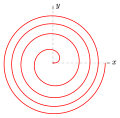 Spiral fermat 1
 -
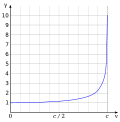 Lorentz factor
 -
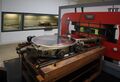 1937 French cyclotron
 -
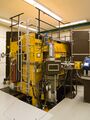 Cyclotron - University of Washington
 -
 M. Stanley Livingston (L) and Ernest O. Lawrence in front of 27-inch cyclotron at the old Radiation Laboratory


Medical Disclaimer: WikiMD is for informational purposes only and is not a substitute for professional medical advice. Content may be inaccurate or outdated and should not be used for diagnosis or treatment. Always consult your healthcare provider for medical decisions. Verify information with trusted sources such as CDC.gov and NIH.gov. By using this site, you agree that WikiMD is not liable for any outcomes related to its content. See full disclaimer.
Credits:Most images are courtesy of Wikimedia commons, and templates, categories Wikipedia, licensed under CC BY SA or similar.
Translate page: - East Asian
中文,
日本,
한국어,
South Asian
हिन्दी,
தமிழ்,
తెలుగు,
Urdu,
ಕನ್ನಡ,
Southeast Asian
Indonesian,
Vietnamese,
Thai,
မြန်မာဘာသာ,
বাংলা
European
español,
Deutsch,
français,
Greek,
português do Brasil,
polski,
română,
русский,
Nederlands,
norsk,
svenska,
suomi,
Italian
Middle Eastern & African
عربى,
Turkish,
Persian,
Hebrew,
Afrikaans,
isiZulu,
Kiswahili,
Other
Bulgarian,
Hungarian,
Czech,
Swedish,
മലയാളം,
मराठी,
ਪੰਜਾਬੀ,
ગુજરાતી,
Portuguese,
Ukrainian

