Cyclic guanosine monophosphate
Cyclic guanosine monophosphate (cGMP) is a cyclic nucleotide derived from guanosine triphosphate (GTP). cGMP acts as a second messenger much like cyclic AMP, most notably by activating intracellular protein kinases in response to the binding of membrane-impermeable peptide hormones to the external cell surface.
Structure and synthesis[edit]
cGMP is synthesized from GTP by the enzyme guanylate cyclase, and is degraded back into GTP by phosphodiesterase. The synthesis and degradation of cGMP are regulated by multiple factors, including the levels of GTP and the activity of guanylate cyclase and phosphodiesterase.
Function[edit]
cGMP serves as a regulator of several biological processes, including vasodilation, insulin secretion, and peristalsis. It also plays a crucial role in the phototransduction pathway in the retina, and in the regulation of cardiac contractility.
In the vascular system, cGMP acts as a potent vasodilator by activating protein kinase G (PKG), which in turn phosphorylates various proteins, leading to relaxation of smooth muscle cells in blood vessels.
In the endocrine system, cGMP is involved in the regulation of insulin secretion by pancreatic beta cells.
In the gastrointestinal system, cGMP is believed to regulate smooth muscle contraction and thus influence peristalsis.
Clinical significance[edit]
Alterations in cGMP levels have been implicated in a variety of disease states, including heart failure, diabetes, and erectile dysfunction. Drugs that increase the levels of cGMP within the body are currently used to treat these and other conditions.
See also[edit]
 | This cell biology article is a stub. You can help WikiMD by expanding the page. |
Cyclic guanosine monophosphate[edit]
-
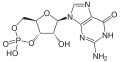 CGMP2
CGMP2 -
 Cyclic guanosine monophosphate anion 3D spacefill
 -
 Cyclic guanosine monophosphate anion ball and stick
 -
 Schematic of cGMP
 -
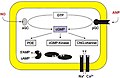 CGMP Rezeptoren


Medical Disclaimer: WikiMD is for informational purposes only and is not a substitute for professional medical advice. Content may be inaccurate or outdated and should not be used for diagnosis or treatment. Always consult your healthcare provider for medical decisions. Verify information with trusted sources such as CDC.gov and NIH.gov. By using this site, you agree that WikiMD is not liable for any outcomes related to its content. See full disclaimer.
Credits:Most images are courtesy of Wikimedia commons, and templates, categories Wikipedia, licensed under CC BY SA or similar.
Translate page: - East Asian
中文,
日本,
한국어,
South Asian
हिन्दी,
தமிழ்,
తెలుగు,
Urdu,
ಕನ್ನಡ,
Southeast Asian
Indonesian,
Vietnamese,
Thai,
မြန်မာဘာသာ,
বাংলা
European
español,
Deutsch,
français,
Greek,
português do Brasil,
polski,
română,
русский,
Nederlands,
norsk,
svenska,
suomi,
Italian
Middle Eastern & African
عربى,
Turkish,
Persian,
Hebrew,
Afrikaans,
isiZulu,
Kiswahili,
Other
Bulgarian,
Hungarian,
Czech,
Swedish,
മലയാളം,
मराठी,
ਪੰਜਾਬੀ,
ગુજરાતી,
Portuguese,
Ukrainian

