Corey–Fuchs reaction
Corey–Fuchs Reaction
The Corey–Fuchs reaction, also known as the Corey–Fuchs alkyne synthesis, is a series of chemical reactions designed to synthesize alkynes from aldehydes. Named after its inventors, Elias James Corey and Philip L. Fuchs, this reaction is a pivotal method in organic chemistry for the formation of carbon-carbon bonds, enabling the transformation of simple aldehydes into more complex alkyne molecules. The Corey–Fuchs reaction is particularly valuable in the synthesis of natural products and pharmaceuticals.
Reaction Mechanism[edit]
The Corey–Fuchs reaction mechanism involves two key steps. Initially, an aldehyde is converted into a dibromide compound through the action of a phosphonium ylide, which is generated from triphenylphosphine (Ph3P) and carbon tetrabromide (CBr4). This step is followed by the elimination of hydrogen bromide (HBr) to form the alkyne. The overall process can be summarized as follows:
1. Formation of the phosphonium ylide from triphenylphosphine and carbon tetrabromide. 2. Reaction of the ylide with an aldehyde to produce a dibromide intermediate. 3. Elimination of HBr from the dibromide to yield the alkyne.
Applications[edit]
The Corey–Fuchs reaction has found widespread application in organic synthesis, particularly in the construction of complex molecular architectures. Its ability to efficiently convert aldehydes into alkynes makes it a valuable tool for the synthesis of natural products, pharmaceuticals, and materials science. Alkynes serve as versatile intermediates in organic synthesis, enabling further transformations into a variety of functional groups.
Limitations[edit]
Despite its utility, the Corey–Fuchs reaction has some limitations. The reaction conditions can sometimes lead to overreaction or the formation of unwanted by-products. Additionally, the use of toxic reagents such as carbon tetrabromide and triphenylphosphine may pose environmental and safety concerns. Researchers continue to explore modifications and alternatives to the Corey–Fuchs reaction to address these limitations.
See Also[edit]
References[edit]
<references/>

-
 Corey–Fuchs reaction scheme
 -
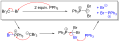 Corey–Fuchs reaction step 1
 -
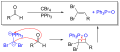 Corey–Fuchs reaction step 2
 -
 Corey–Fuchs reaction step 3


Ad. Transform your health with W8MD Weight Loss, Sleep & MedSpa

Tired of being overweight?
Get started with evidence based, physician-supervised
affordable GLP-1 weight loss injections
Now available in New York City and Philadelphia:
- Semaglutide starting from $59.99/week and up
- Tirzepatide starting from $69.99/week and up (dose dependent)
✔ Evidence-based medical weight loss ✔ Insurance-friendly visits available ✔ Same-week appointments, evenings & weekends
Learn more:
Start your transformation today with W8MD weight loss centers.
|
WikiMD Medical Encyclopedia |
Medical Disclaimer: WikiMD is for informational purposes only and is not a substitute for professional medical advice. Content may be inaccurate or outdated and should not be used for diagnosis or treatment. Always consult your healthcare provider for medical decisions. Verify information with trusted sources such as CDC.gov and NIH.gov. By using this site, you agree that WikiMD is not liable for any outcomes related to its content. See full disclaimer.
Credits:Most images are courtesy of Wikimedia commons, and templates, categories Wikipedia, licensed under CC BY SA or similar.
Translate this page: - East Asian
中文,
日本,
한국어,
South Asian
हिन्दी,
தமிழ்,
తెలుగు,
Urdu,
ಕನ್ನಡ,
Southeast Asian
Indonesian,
Vietnamese,
Thai,
မြန်မာဘာသာ,
বাংলা
European
español,
Deutsch,
français,
Greek,
português do Brasil,
polski,
română,
русский,
Nederlands,
norsk,
svenska,
suomi,
Italian
Middle Eastern & African
عربى,
Turkish,
Persian,
Hebrew,
Afrikaans,
isiZulu,
Kiswahili,
Other
Bulgarian,
Hungarian,
Czech,
Swedish,
മലയാളം,
मराठी,
ਪੰਜਾਬੀ,
ગુજરાતી,
Portuguese,
Ukrainian
