Classical antiquity
Classical Antiquity is a broad term for a long period of cultural history centered on the Mediterranean Sea, comprising the interlocking civilizations of ancient Greece and ancient Rome, collectively known as the Greco-Roman world. It is the period in which Greek and Roman society flourished and wielded great influence throughout Europe, North Africa and Western Asia.
Overview[edit]
Classical Antiquity is characterized by the cultural period of the ancient Greeks and Romans. The cultures of the ancient Greeks and Romans are often grouped together as classical antiquity due to their close proximity in time and geography, as well as their interrelated histories and cultures.
Ancient Greece[edit]
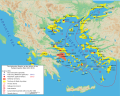
Ancient Greece was a civilization belonging to a period of Greek history that lasted from the Archaic period of the 8th to 6th centuries BC to the end of antiquity (ca. 600 AD). This period saw the rise of the city-states, the establishment of democracy in Athens, the conquests of Alexander the Great, and the flourishing of philosophy, science, and the arts.
Ancient Rome[edit]
Ancity Rome was a civilization that grew out of a small agricultural community founded on the Italian Peninsula as early as the 10th century BC. Located along the Mediterranean Sea, it became one of the largest empires in the ancient world. Rome was known for its architecture, engineering, and political structures which have influenced societies to this day.
Influence on Modern Society[edit]
The influence of Classical Antiquity on modern society can be seen in areas such as government, law, language, architecture, and the arts. The concepts of democracy, republicanism, and the rule of law were all developed during this period and continue to shape political systems today.
See Also[edit]
References[edit]

This WikiMD article can only be edited by registered and verified editors. You can log in or register.
-
 Classical antiquity
 -
 Classical antiquity
 -
 Classical antiquity
 -
 Classical antiquity
 -
 Classical antiquity
 -
 Classical antiquity
 -
Classical antiquity
-
Classical antiquity
-
 Classical antiquity
 -
Classical antiquity


Medical Disclaimer: WikiMD is for informational purposes only and is not a substitute for professional medical advice. Content may be inaccurate or outdated and should not be used for diagnosis or treatment. Always consult your healthcare provider for medical decisions. Verify information with trusted sources such as CDC.gov and NIH.gov. By using this site, you agree that WikiMD is not liable for any outcomes related to its content. See full disclaimer.
Credits:Most images are courtesy of Wikimedia commons, and templates, categories Wikipedia, licensed under CC BY SA or similar.
Translate page: - East Asian
中文,
日本,
한국어,
South Asian
हिन्दी,
தமிழ்,
తెలుగు,
Urdu,
ಕನ್ನಡ,
Southeast Asian
Indonesian,
Vietnamese,
Thai,
မြန်မာဘာသာ,
বাংলা
European
español,
Deutsch,
français,
Greek,
português do Brasil,
polski,
română,
русский,
Nederlands,
norsk,
svenska,
suomi,
Italian
Middle Eastern & African
عربى,
Turkish,
Persian,
Hebrew,
Afrikaans,
isiZulu,
Kiswahili,
Other
Bulgarian,
Hungarian,
Czech,
Swedish,
മലയാളം,
मराठी,
ਪੰਜਾਬੀ,
ગુજરાતી,
Portuguese,
Ukrainian


