Choroid


Choroid is a layer of the eye located between the retina and the sclera. This vascular layer of the eye is primarily responsible for providing oxygen and nourishment to the outer layers of the retina. The choroid contains a dense network of blood vessels and has a pigment that absorbs excess light, thereby preventing visual blurring and light scatter within the eye.
Structure[edit]
The choroid is part of the uvea, which also includes the iris and the ciliary body. The choroid is rich in blood vessels and melanocytes, the cells that produce melanin, the pigment responsible for its color. This pigmentation helps to absorb stray light rays that enter the eye. The choroid is thickest at the back of the eye, near the optic nerve, and becomes thinner towards the front. It is attached to the sclera and the edges of the optic nerve and extends all the way to the ciliary body in the front of the eye.
Function[edit]
The primary function of the choroid is to supply nutrients to the outer layers of the retina. The high vascularization ensures a steady supply of oxygen and essential nutrients to the retina's cells, which is critical for maintaining the health of the photoreceptors that enable vision. Additionally, the choroid removes waste products from the retina, playing a crucial role in retinal metabolism and health.
The choroid's pigmentation is vital for absorbing stray light, thereby enhancing the clarity of the visual image by reducing light scatter. This absorption capacity is crucial for maintaining sharp visual acuity and contrast sensitivity.
Clinical Significance[edit]
Alterations or damage to the choroid can lead to various eye diseases and conditions. For example, choroidal neovascularization (CNV) involves the growth of new blood vessels in the choroid layer, which can lead to wet age-related macular degeneration (AMD), a leading cause of blindness in older adults. Other conditions affecting the choroid include choroiditis, an inflammation of the choroid, and choroidal detachment, which can occur due to trauma or as a complication of eye surgery.
Diagnosis and Treatment[edit]
Imaging techniques such as optical coherence tomography (OCT) and ultrasonography are commonly used to visualize the choroid and diagnose conditions affecting this layer of the eye. Treatment of choroidal disorders depends on the specific condition but may include laser therapy, medication to control inflammation or neovascularization, and surgery in some cases.
Conclusion[edit]
The choroid plays a critical role in the overall health and function of the eye, particularly in supporting the retina. Understanding the structure, function, and potential diseases of the choroid is essential for diagnosing and treating various eye conditions, thereby preserving vision and improving the quality of life for those affected.
 | This medical article is a stub. You can help WikiMD by expanding the page. |
-
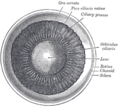 Choroid


Medical Disclaimer: WikiMD is for informational purposes only and is not a substitute for professional medical advice. Content may be inaccurate or outdated and should not be used for diagnosis or treatment. Always consult your healthcare provider for medical decisions. Verify information with trusted sources such as CDC.gov and NIH.gov. By using this site, you agree that WikiMD is not liable for any outcomes related to its content. See full disclaimer.
Credits:Most images are courtesy of Wikimedia commons, and templates, categories Wikipedia, licensed under CC BY SA or similar.
Translate page: - East Asian
中文,
日本,
한국어,
South Asian
हिन्दी,
தமிழ்,
తెలుగు,
Urdu,
ಕನ್ನಡ,
Southeast Asian
Indonesian,
Vietnamese,
Thai,
မြန်မာဘာသာ,
বাংলা
European
español,
Deutsch,
français,
Greek,
português do Brasil,
polski,
română,
русский,
Nederlands,
norsk,
svenska,
suomi,
Italian
Middle Eastern & African
عربى,
Turkish,
Persian,
Hebrew,
Afrikaans,
isiZulu,
Kiswahili,
Other
Bulgarian,
Hungarian,
Czech,
Swedish,
മലയാളം,
मराठी,
ਪੰਜਾਬੀ,
ગુજરાતી,
Portuguese,
Ukrainian

