Breast measurement
Breast measurement or bust measurement is the measurement around a woman's torso at the fullest part of the breast. The measurements are usually obtained for personal, medical, or fashion-related reasons.
Measurement Techniques[edit]
Breast measurements are often taken during a physical examination or for custom clothing. The measurement is taken with a flexible tape measure around the torso, level with the fullest part of the breasts. This measurement is not the same as the woman's bra size, which involves additional measurements.
Bra Size Calculation[edit]
The bra size is calculated using the bust measurement and the band size measurement. The band size is the measurement around the woman's torso under the breasts. The difference between the bust measurement and the band size determines the cup size. For example, a one-inch difference would indicate an "A" cup, a two-inch difference a "B" cup, and so on.
Cultural Significance[edit]
Breast measurements, particularly in the context of bra size, have cultural significance in many societies. They can be associated with femininity, sexual attractiveness, and body image. However, societal focus on breast size can also lead to body dysmorphia and other mental health issues.
Health Implications[edit]
Breast measurements can have health implications. For example, a sudden increase in breast size can indicate pregnancy or hormonal changes. Additionally, breast size can impact physical comfort and posture, and large breasts can cause back pain and other physical discomfort.
See Also[edit]
 | This fashion-related article is a stub. You can help WikiMD by expanding the page. |
 | This medical article is a stub. You can help WikiMD by expanding the page. |
-
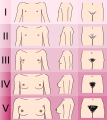 Tanner scale for female breast development
 -
Posture Foundation Garments illustration
-
Bra size labeling according to EN 13402
-
Measurement of breast hemicircumference


Medical Disclaimer: WikiMD is for informational purposes only and is not a substitute for professional medical advice. Content may be inaccurate or outdated and should not be used for diagnosis or treatment. Always consult your healthcare provider for medical decisions. Verify information with trusted sources such as CDC.gov and NIH.gov. By using this site, you agree that WikiMD is not liable for any outcomes related to its content. See full disclaimer.
Credits:Most images are courtesy of Wikimedia commons, and templates, categories Wikipedia, licensed under CC BY SA or similar.
Translate page: - East Asian
中文,
日本,
한국어,
South Asian
हिन्दी,
தமிழ்,
తెలుగు,
Urdu,
ಕನ್ನಡ,
Southeast Asian
Indonesian,
Vietnamese,
Thai,
မြန်မာဘာသာ,
বাংলা
European
español,
Deutsch,
français,
Greek,
português do Brasil,
polski,
română,
русский,
Nederlands,
norsk,
svenska,
suomi,
Italian
Middle Eastern & African
عربى,
Turkish,
Persian,
Hebrew,
Afrikaans,
isiZulu,
Kiswahili,
Other
Bulgarian,
Hungarian,
Czech,
Swedish,
മലയാളം,
मराठी,
ਪੰਜਾਬੀ,
ગુજરાતી,
Portuguese,
Ukrainian


