Risk factors for breast cancer
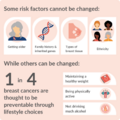
Risk factors for breast cancer are aspects that increase the likelihood of developing breast cancer. These factors can be divided into two main categories: modifiable and non-modifiable risk factors. Modifiable risk factors are those that can be changed or controlled, such as lifestyle choices, while non-modifiable risk factors are those that cannot be changed, such as age and genetics.
Non-modifiable Risk Factors[edit]
Age[edit]
Age is a significant risk factor for breast cancer. The risk of developing breast cancer increases as a woman gets older, particularly after menopause.
Genetics[edit]
Approximately 5-10% of breast cancers are thought to be hereditary, caused by abnormal genes passed from parent to child. The most common cause of hereditary breast cancer is an inherited mutation in the BRCA1 or BRCA2 gene.
Family History[edit]
A woman’s risk of breast cancer nearly doubles if she has a first-degree relative (mother, sister, daughter) who has been diagnosed with breast cancer.
Modifiable Risk Factors[edit]
Alcohol[edit]
The consumption of alcohol is clearly linked to an increased risk of developing breast cancer. The risk increases with the amount of alcohol consumed.
Weight[edit]
Being overweight or obese increases the risk of breast cancer, especially for women after menopause.
Physical Activity[edit]
A lack of physical activity can increase your risk of developing breast cancer.
Prevention[edit]
While you can't control some breast cancer risk factors—family history and aging, for example—there are some risk factors that you can control, which include being physically active, maintaining a healthy weight, and limiting alcohol intake.
See Also[edit]
 | This medical article is a stub. You can help WikiMD by expanding the page. |
-
 Risk factors for breast cancer
 -
 Breast cancer age risk
 -
 Bisphenol A
 -
 Benzene


Medical Disclaimer: WikiMD is for informational purposes only and is not a substitute for professional medical advice. Content may be inaccurate or outdated and should not be used for diagnosis or treatment. Always consult your healthcare provider for medical decisions. Verify information with trusted sources such as CDC.gov and NIH.gov. By using this site, you agree that WikiMD is not liable for any outcomes related to its content. See full disclaimer.
Credits:Most images are courtesy of Wikimedia commons, and templates, categories Wikipedia, licensed under CC BY SA or similar.
Translate page: - East Asian
中文,
日本,
한국어,
South Asian
हिन्दी,
தமிழ்,
తెలుగు,
Urdu,
ಕನ್ನಡ,
Southeast Asian
Indonesian,
Vietnamese,
Thai,
မြန်မာဘာသာ,
বাংলা
European
español,
Deutsch,
français,
Greek,
português do Brasil,
polski,
română,
русский,
Nederlands,
norsk,
svenska,
suomi,
Italian
Middle Eastern & African
عربى,
Turkish,
Persian,
Hebrew,
Afrikaans,
isiZulu,
Kiswahili,
Other
Bulgarian,
Hungarian,
Czech,
Swedish,
മലയാളം,
मराठी,
ਪੰਜਾਬੀ,
ગુજરાતી,
Portuguese,
Ukrainian

