Connecting stalk
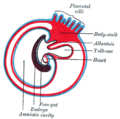
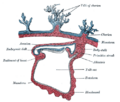
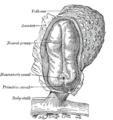
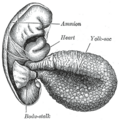
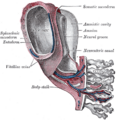
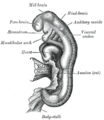
Connecting Stalk is a structure in embryology that connects the developing embryo to the chorion, an outer layer that interacts with maternal tissues to form the placenta. The connecting stalk later forms the umbilical cord.
Structure[edit]
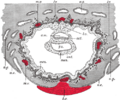
The connecting stalk is a structure that forms during the third week of embryonic development. It is initially located on the ventral side of the embryo, but as the embryo folds, it moves to a position at the base of the umbilical cord. The connecting stalk is composed of extra-embryonic mesoderm and contains the allantois, a tube that extends from the yolk sac into the connecting stalk.
Development[edit]
The connecting stalk plays a crucial role in the development of the placenta. It contains the allantois, which is involved in early fluid exchange between the embryo and the yolk sac. The allantois eventually becomes part of the umbilical cord, which provides the fetus with nutrients and oxygen from the mother's bloodstream.
Clinical Significance[edit]
Abnormalities in the development of the connecting stalk can lead to complications such as omphalocele, a birth defect in which organs protrude from the umbilicus, and gastroschisis, a condition where the baby's intestines stick out of the baby's body through a defect on one side of the umbilical cord.
See Also[edit]
References[edit]

This WikiMD article can only be edited by registered and verified editors. You can log in or register.
-
 Connecting_stalk
 -
 Connecting_stalk
 -
 Connecting_stalk
 -
 Connecting_stalk
 -
 Connecting_stalk
 -
 Connecting_stalk
 -
 Connecting_stalk


Medical Disclaimer: WikiMD is for informational purposes only and is not a substitute for professional medical advice. Content may be inaccurate or outdated and should not be used for diagnosis or treatment. Always consult your healthcare provider for medical decisions. Verify information with trusted sources such as CDC.gov and NIH.gov. By using this site, you agree that WikiMD is not liable for any outcomes related to its content. See full disclaimer.
Credits:Most images are courtesy of Wikimedia commons, and templates, categories Wikipedia, licensed under CC BY SA or similar.
Translate page: - East Asian
中文,
日本,
한국어,
South Asian
हिन्दी,
தமிழ்,
తెలుగు,
Urdu,
ಕನ್ನಡ,
Southeast Asian
Indonesian,
Vietnamese,
Thai,
မြန်မာဘာသာ,
বাংলা
European
español,
Deutsch,
français,
Greek,
português do Brasil,
polski,
română,
русский,
Nederlands,
norsk,
svenska,
suomi,
Italian
Middle Eastern & African
عربى,
Turkish,
Persian,
Hebrew,
Afrikaans,
isiZulu,
Kiswahili,
Other
Bulgarian,
Hungarian,
Czech,
Swedish,
മലയാളം,
मराठी,
ਪੰਜਾਬੀ,
ગુજરાતી,
Portuguese,
Ukrainian

