Blue cheese
Blue cheese is a general term used to classify cheeses that have been cultured with the mold Penicillium, resulting in spots or veins of blue, blue-gray or blue-green mold throughout the cheese. The distinct flavor and aroma of blue cheese are recognized as being sharp, salty, and strong.
History[edit]
The discovery of blue cheese is believed to have been an accident. The cheeses were stored in natural temperatures and moisture-controlled caves, which happen to be favorable environments for many varieties of harmless mold. After the discovery of Penicillium roqueforti, the mold used to make blue cheese, the process of making blue cheese was refined and perfected.
Production[edit]
Blue cheese is made from cow's, sheep's, or goat's milk. During the cheese-making process, Penicillium cultures are added. The cheese is then aged in a temperature-controlled environment such as a cave. Blue cheese can be eaten by itself or can be spread, crumbled or melted into or over a range of different recipes.
Varieties[edit]
There are many varieties of blue cheese, some of the most well-known include:
- Roquefort: A French blue cheese made from sheep's milk.
- Gorgonzola: An Italian blue cheese made from cow's milk.
- Stilton: An English blue cheese made from cow's milk.
- Danish Blue: A Danish blue cheese made from cow's milk.
Health Benefits[edit]
Blue cheese is rich in protein, calcium, and vitamin B12. However, it is also high in sodium and cholesterol, which should be considered for those with dietary restrictions.
See Also[edit]
 | This cheese-related article is a stub. You can help WikiMD by expanding the page. |
-
 Bleu au lait de chèvre
 -
 Bleu de Gex
 -
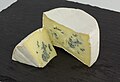 Bavaria blu
 -
 Jersey Blue
 -
 Blue cheese plates
 -
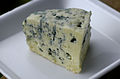 Gorgonzola
 -
 Homemade Stilton Blue Cheese
 -
 Roquefort
 -
 A Plate of Blue Cheese at Lighthouse Cafe
 -
 A Blue Cheese from Holiday Inn Goldmile
 -
 A Danish Blue Cheese with Fig from The Astor
 -
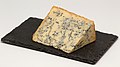 Blue Stilton
 -
 Stichleton


Medical Disclaimer: WikiMD is for informational purposes only and is not a substitute for professional medical advice. Content may be inaccurate or outdated and should not be used for diagnosis or treatment. Always consult your healthcare provider for medical decisions. Verify information with trusted sources such as CDC.gov and NIH.gov. By using this site, you agree that WikiMD is not liable for any outcomes related to its content. See full disclaimer.
Credits:Most images are courtesy of Wikimedia commons, and templates, categories Wikipedia, licensed under CC BY SA or similar.
Translate this page: - East Asian
中文,
日本,
한국어,
South Asian
हिन्दी,
தமிழ்,
తెలుగు,
Urdu,
ಕನ್ನಡ,
Southeast Asian
Indonesian,
Vietnamese,
Thai,
မြန်မာဘာသာ,
বাংলা
European
español,
Deutsch,
français,
Greek,
português do Brasil,
polski,
română,
русский,
Nederlands,
norsk,
svenska,
suomi,
Italian
Middle Eastern & African
عربى,
Turkish,
Persian,
Hebrew,
Afrikaans,
isiZulu,
Kiswahili,
Other
Bulgarian,
Hungarian,
Czech,
Swedish,
മലയാളം,
मराठी,
ਪੰਜਾਬੀ,
ગુજરાતી,
Portuguese,
Ukrainian
