Muscle architecture
Muscle Architecture refers to the physical arrangement of muscle fibers relative to the axis of force generation. The architecture of a muscle significantly influences its mechanical function. The three primary types of muscle architecture are longitudinal, unipennate, and multipennate.
Etymology[edit]
The term 'muscle architecture' is derived from the Latin 'musculus' meaning 'little mouse' and the Greek 'architekton' meaning 'master builder'. The term reflects the intricate design and structure of muscle fibers.
Longitudinal Muscles[edit]
Longitudinal muscles are characterized by fibers that run parallel to the axis of force generation. This type of muscle architecture is common in muscles that require a large range of motion, such as the sartorius muscle in the human leg.
Unipennate Muscles[edit]
Unipennate muscles have fibers that are oriented at an angle to the axis of force generation. This arrangement allows for a greater number of fibers in a given volume of muscle, which can generate more force than a similarly sized muscle with longitudinal architecture. An example of a unipennate muscle is the semimembranosus muscle in the human leg.
Multipennate Muscles[edit]
Multipennate muscles have multiple rows of diagonal fibers, with a central tendon branching into two or more tendons. This type of muscle architecture allows for even greater force generation, but at the cost of a reduced range of motion. An example of a multipennate muscle is the deltoid muscle in the human shoulder.
Related Terms[edit]
- Muscle fiber: The individual contractile units that make up a muscle.
- Tendon: The connective tissue that transmits the force generated by a muscle to the bone.
- Force generation: The process by which muscles produce movement.
See Also[edit]

This WikiMD article can only be edited by registered and verified editors. You can log in or register.
-
Muscle architecture
-
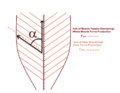 Pennation angle of fibers in pennate muscle


Medical Disclaimer: WikiMD is for informational purposes only and is not a substitute for professional medical advice. Content may be inaccurate or outdated and should not be used for diagnosis or treatment. Always consult your healthcare provider for medical decisions. Verify information with trusted sources such as CDC.gov and NIH.gov. By using this site, you agree that WikiMD is not liable for any outcomes related to its content. See full disclaimer.
Credits:Most images are courtesy of Wikimedia commons, and templates, categories Wikipedia, licensed under CC BY SA or similar.
Translate page: - East Asian
中文,
日本,
한국어,
South Asian
हिन्दी,
தமிழ்,
తెలుగు,
Urdu,
ಕನ್ನಡ,
Southeast Asian
Indonesian,
Vietnamese,
Thai,
မြန်မာဘာသာ,
বাংলা
European
español,
Deutsch,
français,
Greek,
português do Brasil,
polski,
română,
русский,
Nederlands,
norsk,
svenska,
suomi,
Italian
Middle Eastern & African
عربى,
Turkish,
Persian,
Hebrew,
Afrikaans,
isiZulu,
Kiswahili,
Other
Bulgarian,
Hungarian,
Czech,
Swedish,
മലയാളം,
मराठी,
ਪੰਜਾਬੀ,
ગુજરાતી,
Portuguese,
Ukrainian


