Axillary artery
Axillary artery is a large blood vessel that conveys oxygenated blood to various parts of the upper body, including the pectoral region, axilla, and upper limb. It is a continuation of the subclavian artery and becomes the brachial artery after it crosses the lower border of the teres major muscle.
Anatomy[edit]
The axillary artery begins at the lateral border of the first rib, becoming the brachial artery at the lower border of the teres major. It is divided into three parts by the pectoralis minor muscle. The first part contains one branch, the second part two branches, and the third part three branches.
Branches[edit]
The axillary artery gives off several branches, which supply blood to the chest, shoulder, and upper limb. These include:
- Superior thoracic artery
- Thoracoacromial artery
- Lateral thoracic artery
- Subscapular artery
- Anterior circumflex humeral artery
- Posterior circumflex humeral artery
Clinical significance[edit]
The axillary artery is of clinical importance in several medical and surgical contexts. It can be involved in thoracic outlet syndrome, aneurysm, and arteriovenous fistula. It is also a common site for arterial puncture during cardiac catheterization.
See also[edit]

Axillary_artery[edit]
-
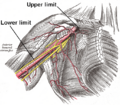 Axillary limits
 -
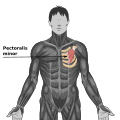 Pectoralis minor
 -
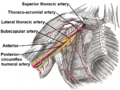 Axillary branches
 -
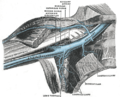 Gray's Anatomy Plate 576
 -
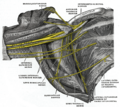 Gray's Anatomy Plate 809
 -
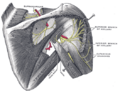 Gray's Anatomy Plate 810
 -
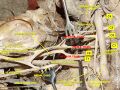 Plexus brachialis
 -
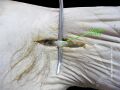 Slide 3v
 -
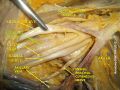 Slide 2bbbb
 -
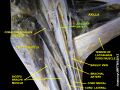 Slide 9JJJ
 -
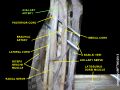 Slide 11OOO
 -
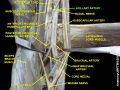 Slide 15SSS


Medical Disclaimer: WikiMD is for informational purposes only and is not a substitute for professional medical advice. Content may be inaccurate or outdated and should not be used for diagnosis or treatment. Always consult your healthcare provider for medical decisions. Verify information with trusted sources such as CDC.gov and NIH.gov. By using this site, you agree that WikiMD is not liable for any outcomes related to its content. See full disclaimer.
Credits:Most images are courtesy of Wikimedia commons, and templates, categories Wikipedia, licensed under CC BY SA or similar.
Translate page: - East Asian
中文,
日本,
한국어,
South Asian
हिन्दी,
தமிழ்,
తెలుగు,
Urdu,
ಕನ್ನಡ,
Southeast Asian
Indonesian,
Vietnamese,
Thai,
မြန်မာဘာသာ,
বাংলা
European
español,
Deutsch,
français,
Greek,
português do Brasil,
polski,
română,
русский,
Nederlands,
norsk,
svenska,
suomi,
Italian
Middle Eastern & African
عربى,
Turkish,
Persian,
Hebrew,
Afrikaans,
isiZulu,
Kiswahili,
Other
Bulgarian,
Hungarian,
Czech,
Swedish,
മലയാളം,
मराठी,
ਪੰਜਾਬੀ,
ગુજરાતી,
Portuguese,
Ukrainian

