Toxicodendron diversilobum
Species of flowering plant in the sumac family, Anacardiaceae
Toxicodendron diversilobum, commonly known as Pacific poison oak, is a plant species in the Anacardiaceae family. It is native to western North America, where it is found in a variety of habitats, including forests, woodlands, and grasslands. The plant is well-known for causing contact dermatitis in humans due to the presence of urushiol, an oily compound found in its leaves, stems, and roots.
Description[edit]
Toxicodendron diversilobum is a deciduous shrub or vine that can grow up to 3 meters (10 feet) tall as a shrub or climb up to 30 meters (100 feet) as a vine. The leaves are alternate and compound, typically with three leaflets, although the number can vary. The leaflets are glossy green, turning red or orange in the fall.
The plant produces small, greenish-white flowers in the spring, which are followed by small, white or tan berries. The berries are an important food source for birds and other wildlife.
Habitat and Distribution[edit]
Toxicodendron diversilobum is found along the Pacific Coast of North America, from southern British Columbia to Baja California. It thrives in a variety of environments, including coastal bluffs, open woodlands, and chaparral. The plant is adaptable to different soil types and can tolerate both sun and shade.
Toxicity[edit]
The primary irritant in Toxicodendron diversilobum is urushiol, a compound that can cause an allergic reaction in many people. Contact with the plant can result in a rash, itching, and blistering. The severity of the reaction varies among individuals.
Ecological Role[edit]
Despite its reputation as a nuisance to humans, Toxicodendron diversilobum plays an important role in its ecosystem. The plant provides food and habitat for a variety of animals. Birds, such as the California towhee and the American robin, eat the berries, while deer and other mammals browse the leaves.
Cultural Significance[edit]
Indigenous peoples of the Pacific Northwest have historically used Toxicodendron diversilobum for various purposes, including as a dye and in basketry. However, they were also aware of its toxic properties and took care to avoid contact with the plant.
Management and Control[edit]
Controlling Toxicodendron diversilobum in areas where it is not desired can be challenging. Mechanical removal, such as pulling or cutting, is often used, but care must be taken to avoid skin contact. Herbicides can also be effective, but they must be used with caution to avoid harming non-target plants.
Related Pages[edit]
Gallery[edit]
-
 Berries of Toxicodendron diversilobum
 -
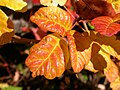 Pacific poison oak
 -
 Smaller leaves of Toxicodendron diversilobum


Ad. Transform your life with W8MD's Budget GLP-1 injections from $49.99


W8MD offers a medical weight loss program to lose weight in Philadelphia. Our physician-supervised medical weight loss provides:
- Weight loss injections in NYC (generic and brand names):
- Zepbound / Mounjaro, Wegovy / Ozempic, Saxenda
- Most insurances accepted or discounted self-pay rates. We will obtain insurance prior authorizations if needed.
- Generic GLP1 weight loss injections from $49.99 for the starting dose of Semaglutide and $65.00 for Tirzepatide.
- Also offer prescription weight loss medications including Phentermine, Qsymia, Diethylpropion, Contrave etc.
NYC weight loss doctor appointmentsNYC weight loss doctor appointments
Start your NYC weight loss journey today at our NYC medical weight loss and Philadelphia medical weight loss clinics.
- Call 718-946-5500 to lose weight in NYC or for medical weight loss in Philadelphia 215-676-2334.
- Tags:NYC medical weight loss, Philadelphia lose weight Zepbound NYC, Budget GLP1 weight loss injections, Wegovy Philadelphia, Wegovy NYC, Philadelphia medical weight loss, Brookly weight loss and Wegovy NYC


|
WikiMD's Wellness Encyclopedia |
| Let Food Be Thy Medicine Medicine Thy Food - Hippocrates |
Medical Disclaimer: WikiMD is not a substitute for professional medical advice. The information on WikiMD is provided as an information resource only, may be incorrect, outdated or misleading, and is not to be used or relied on for any diagnostic or treatment purposes. Please consult your health care provider before making any healthcare decisions or for guidance about a specific medical condition. WikiMD expressly disclaims responsibility, and shall have no liability, for any damages, loss, injury, or liability whatsoever suffered as a result of your reliance on the information contained in this site. By visiting this site you agree to the foregoing terms and conditions, which may from time to time be changed or supplemented by WikiMD. If you do not agree to the foregoing terms and conditions, you should not enter or use this site. See full disclaimer.
Credits:Most images are courtesy of Wikimedia commons, and templates, categories Wikipedia, licensed under CC BY SA or similar.
Translate this page: - East Asian
中文,
日本,
한국어,
South Asian
हिन्दी,
தமிழ்,
తెలుగు,
Urdu,
ಕನ್ನಡ,
Southeast Asian
Indonesian,
Vietnamese,
Thai,
မြန်မာဘာသာ,
বাংলা
European
español,
Deutsch,
français,
Greek,
português do Brasil,
polski,
română,
русский,
Nederlands,
norsk,
svenska,
suomi,
Italian
Middle Eastern & African
عربى,
Turkish,
Persian,
Hebrew,
Afrikaans,
isiZulu,
Kiswahili,
Other
Bulgarian,
Hungarian,
Czech,
Swedish,
മലയാളം,
मराठी,
ਪੰਜਾਬੀ,
ગુજરાતી,
Portuguese,
Ukrainian


