Leopold Auenbrugger
Leopold Auenbrugger (1722–1809) was an Austrian physician and a pioneer in the field of medicine. He is best known for inventing the technique of percussion as a diagnostic tool in medicine. This method involves tapping on a patient's chest and listening to the resulting sounds to diagnose conditions of the heart and lungs. Auenbrugger's innovation marked a significant advancement in clinical diagnosis and remains a fundamental practice in modern medicine.
Early Life and Education[edit]
Leopold Auenbrugger was born on November 19, 1722, in Graz, Austria. He was the son of a prosperous innkeeper, which exposed him to the sounds of tapping on wine barrels to gauge their fullness, an experience that later influenced his medical innovation. Auenbrugger pursued his medical education at the University of Vienna, where he showed a keen interest in advancing medical knowledge and practices.
Career and Contributions[edit]
After completing his studies, Auenbrugger began working at the Spanish Military Hospital in Vienna. It was here that he developed and refined the technique of chest percussion. In 1761, he published his findings in a book titled Inventum Novum ex Percussione Thoracis Humani ut Signo Abstrusos Interni Pectoris Morbos Detegendi (A New Discovery that Enables the Physician from the Percussion of the Human Thorax to Detect the Diseases Hidden Within the Chest). This work described how different sounds produced through percussion could indicate the health of the underlying chest organs.
Despite the significance of his discovery, Auenbrugger's method was initially met with skepticism and did not gain widespread acceptance. It was not until French physician Jean-Nicolas Corvisart translated and endorsed Auenbrugger's work in 1808 that percussion became a standard diagnostic tool in medicine.
Legacy[edit]
Leopold Auenbrugger's invention of percussion as a diagnostic technique has had a lasting impact on the field of medicine. His method laid the groundwork for further advancements in the diagnosis and treatment of thoracic diseases. Auenbrugger's work is a testament to the importance of observation, innovation, and perseverance in the advancement of medical science.
Death[edit]
Leopold Auenbrugger passed away on May 17, 1809, in Vienna, Austria. His contributions to medicine, however, continue to live on, influencing countless generations of physicians and improving the care of patients with heart and lung conditions.
See Also[edit]

-
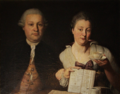 Leopold Auenbrugger and his wife Marianne

Ad. Transform your life with W8MD's
GLP-1 weight loss injections special from $29.99 with insurance
|
WikiMD Medical Encyclopedia |
Medical Disclaimer: WikiMD is for informational purposes only and is not a substitute for professional medical advice. Content may be inaccurate or outdated and should not be used for diagnosis or treatment. Always consult your healthcare provider for medical decisions. Verify information with trusted sources such as CDC.gov and NIH.gov. By using this site, you agree that WikiMD is not liable for any outcomes related to its content. See full disclaimer.
Credits:Most images are courtesy of Wikimedia commons, and templates, categories Wikipedia, licensed under CC BY SA or similar.
Translate this page: - East Asian
中文,
日本,
한국어,
South Asian
हिन्दी,
தமிழ்,
తెలుగు,
Urdu,
ಕನ್ನಡ,
Southeast Asian
Indonesian,
Vietnamese,
Thai,
မြန်မာဘာသာ,
বাংলা
European
español,
Deutsch,
français,
Greek,
português do Brasil,
polski,
română,
русский,
Nederlands,
norsk,
svenska,
suomi,
Italian
Middle Eastern & African
عربى,
Turkish,
Persian,
Hebrew,
Afrikaans,
isiZulu,
Kiswahili,
Other
Bulgarian,
Hungarian,
Czech,
Swedish,
മലയാളം,
मराठी,
ਪੰਜਾਬੀ,
ગુજરાતી,
Portuguese,
Ukrainian
