Lacrimal canaliculi
Lacrimal canaliculi (singular: lacrimal canaliculus), also known as tear ducts, are part of the lacrimal apparatus that serves as the physical drainage pathway for tears. They are small, tubular structures that play a crucial role in the tear film's lifecycle, ensuring that tears can drain from the eye's surface into the nasolacrimal duct, eventually reaching the nasal cavity.
Anatomy[edit]
The lacrimal canaliculi begin at the puncta lacrimalia, tiny openings located on the lacrimal papilla near the inner corner of each eyelid. Each eye has two canaliculi, the upper and the lower, which drain tears from the respective upper and lower puncta. After originating from the puncta, the canaliculi travel vertically for a short distance (about 2mm) before making a sharp turn horizontally towards the lacrimal sac. This junction, where the canaliculi meet the lacrimal sac, is known as the ampulla. The canaliculi are lined with a mucous membrane, allowing for the smooth passage of tears.
Function[edit]
The primary function of the lacrimal canaliculi is to facilitate the drainage of tears from the eye's surface. Tears are produced by the lacrimal gland and spread across the eye's surface with each blink. These tears collect at the eye's medial (inner) corner, where they enter the puncta and subsequently the lacrimal canaliculi. Through a series of blinks, tears are pumped through the canaliculi into the lacrimal sac and down the nasolacrimal duct, ultimately draining into the nasal cavity. This process is essential for eye health, as it helps to remove debris and maintain a moist environment on the eye's surface.
Clinical Significance[edit]
Blockage or dysfunction of the lacrimal canaliculi can lead to dacryocystitis, an inflammation of the lacrimal sac, or epiphora, an overflow of tears onto the face. Causes of canaliculi dysfunction can include infection, inflammation, trauma, or congenital anomalies. Diagnosis of canaliculi issues may involve dacryocystography, a radiographic examination of the tear drainage system, or dacryoscintigraphy, a nuclear medicine test. Treatment options vary depending on the underlying cause but may include antibiotics for infection, surgery to remove blockages, or the insertion of a lacrimal stent or Jones tube to facilitate tear drainage.
See Also[edit]
References[edit]
<references/>

Lacrimal canaliculi gallery[edit]
-
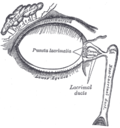 Gray896

Ad. Transform your health with W8MD Weight Loss, Sleep & MedSpa

Tired of being overweight?
Special offer:
Budget GLP-1 weight loss medications
- Semaglutide starting from $29.99/week and up with insurance for visit of $59.99 and up per week self pay.
- Tirzepatide starting from $45.00/week and up (dose dependent) or $69.99/week and up self pay
✔ Same-week appointments, evenings & weekends
Learn more:
- GLP-1 weight loss clinic NYC
- W8MD's NYC medical weight loss
- W8MD Philadelphia GLP-1 shots
- Philadelphia GLP-1 injections
- Affordable GLP-1 shots NYC
|
WikiMD Medical Encyclopedia |
Medical Disclaimer: WikiMD is for informational purposes only and is not a substitute for professional medical advice. Content may be inaccurate or outdated and should not be used for diagnosis or treatment. Always consult your healthcare provider for medical decisions. Verify information with trusted sources such as CDC.gov and NIH.gov. By using this site, you agree that WikiMD is not liable for any outcomes related to its content. See full disclaimer.
Credits:Most images are courtesy of Wikimedia commons, and templates, categories Wikipedia, licensed under CC BY SA or similar.
Translate this page: - East Asian
中文,
日本,
한국어,
South Asian
हिन्दी,
தமிழ்,
తెలుగు,
Urdu,
ಕನ್ನಡ,
Southeast Asian
Indonesian,
Vietnamese,
Thai,
မြန်မာဘာသာ,
বাংলা
European
español,
Deutsch,
français,
Greek,
português do Brasil,
polski,
română,
русский,
Nederlands,
norsk,
svenska,
suomi,
Italian
Middle Eastern & African
عربى,
Turkish,
Persian,
Hebrew,
Afrikaans,
isiZulu,
Kiswahili,
Other
Bulgarian,
Hungarian,
Czech,
Swedish,
മലയാളം,
मराठी,
ਪੰਜਾਬੀ,
ગુજરાતી,
Portuguese,
Ukrainian
