Hexahydrocannabivarin
Hexahydrocannabivarin (HHC) is a cannabinoid found in the Cannabis plant. It is one of the many phytocannabinoids that contribute to the plant's medicinal properties.
Chemistry[edit]
Hexahydrocannabivarin is a homologue of tetrahydrocannabivarin (THCV) and differs only by the cyclohexene ring being fully saturated. It is categorized as a propyl cannabinoid, meaning its molecular structure includes a propyl side chain.
Pharmacology[edit]
The pharmacological effects of HHC are not fully understood. However, it is known to interact with the endocannabinoid system in the human body, which is involved in a variety of physiological processes. HHC is believed to act as a CB1 receptor antagonist and CB2 receptor partial agonist, similar to its analogue THCV.
Medical Use[edit]
While the medical use of HHC is still under investigation, preliminary research suggests it may have potential therapeutic benefits. These could include anti-inflammatory, analgesic, and neuroprotective effects. However, more research is needed to fully understand the medical potential of HHC.
Legal Status[edit]
The legal status of HHC varies by country and in some cases, by state or province. In many jurisdictions, it is regulated under laws pertaining to cannabis and cannabinoids.
See Also[edit]
References[edit]
<references />

-
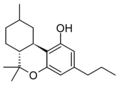 Hexahydrocannabivarin

Ad. Transform your life with W8MD's
GLP-1 weight loss injections special from $29.99 with insurance
|
WikiMD Medical Encyclopedia |
Medical Disclaimer: WikiMD is for informational purposes only and is not a substitute for professional medical advice. Content may be inaccurate or outdated and should not be used for diagnosis or treatment. Always consult your healthcare provider for medical decisions. Verify information with trusted sources such as CDC.gov and NIH.gov. By using this site, you agree that WikiMD is not liable for any outcomes related to its content. See full disclaimer.
Credits:Most images are courtesy of Wikimedia commons, and templates, categories Wikipedia, licensed under CC BY SA or similar.
Translate this page: - East Asian
中文,
日本,
한국어,
South Asian
हिन्दी,
தமிழ்,
తెలుగు,
Urdu,
ಕನ್ನಡ,
Southeast Asian
Indonesian,
Vietnamese,
Thai,
မြန်မာဘာသာ,
বাংলা
European
español,
Deutsch,
français,
Greek,
português do Brasil,
polski,
română,
русский,
Nederlands,
norsk,
svenska,
suomi,
Italian
Middle Eastern & African
عربى,
Turkish,
Persian,
Hebrew,
Afrikaans,
isiZulu,
Kiswahili,
Other
Bulgarian,
Hungarian,
Czech,
Swedish,
മലയാളം,
मराठी,
ਪੰਜਾਬੀ,
ગુજરાતી,
Portuguese,
Ukrainian
