Rail stressing
Rail stressing is a critical process in the construction and maintenance of railway track systems. It involves the intentional application of stress to rail tracks to compensate for thermal expansion and contraction, which can cause tracks to lengthen or shorten with temperature changes. This process is essential for maintaining the integrity and safety of rail infrastructure.
Overview[edit]
Rail stressing is based on the principle of thermal expansion, a physical property of materials that causes them to change in size in response to changes in temperature. Rail tracks, made primarily of steel, expand in hot weather and contract in cold weather. If not properly managed, this expansion and contraction can lead to track deformities, such as rail buckling in the heat or rail breaks in the cold. Rail stressing counteracts these forces by pre-applying tension or compression to the rails, ensuring they remain stable across a range of temperatures.
Types of Rail Stressing[edit]
There are two main types of rail stressing: stress-relieved track and continuous welded rail (CWR).
Stress-Relieved Track[edit]
Stress-relieved track involves the use of individual rail sections bolted together with gaps between them, known as expansion joints, to allow for thermal expansion. This method is less commonly used today due to its higher maintenance requirements and the smoother ride provided by CWR.
Continuous Welded Rail[edit]
CWR is the most common form of rail stressing today. It involves welding rail sections together to form a single, continuous length of rail. Specialized equipment is used to pre-stress the rail by either heating it (thermal stressing) or mechanically stretching it (mechanical stressing) before it is secured to the railroad ties. This pre-stressing is calculated to ensure that the rail will not buckle or break under temperature extremes.
Process[edit]
The process of rail stressing varies depending on the type of stressing being applied. However, it generally involves the following steps:
1. **Preparation**: The rail is inspected and measured to determine the amount of stress that needs to be applied. 2. **Application of Stress**: For CWR, this can involve heating the rail with torches (thermal stressing) or using hydraulic equipment to stretch the rail (mechanical stressing). 3. **Securing the Rail**: Once the rail has been stressed, it is fastened to the railroad ties with rail fasteners to maintain the applied stress. 4. **Inspection and Adjustment**: The stressed rail is inspected to ensure it has been correctly stressed. Adjustments are made as necessary.
Safety and Maintenance[edit]
Properly stressed rails are crucial for the safety of rail operations. Regular inspections and maintenance are required to ensure that the stresses applied to the rails remain within safe limits. This includes monitoring for signs of wear, checking the integrity of welds, and ensuring that the rail remains properly aligned.
Conclusion[edit]
Rail stressing is a vital process in the construction and maintenance of railway tracks, ensuring that they can withstand the forces of thermal expansion and contraction. By carefully applying and maintaining stress in the rails, railway operators can prevent track deformities and ensure the safe and efficient operation of trains.

-
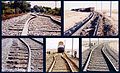 Rail buckle
 -
 Continuous welded rail track


Ad. Transform your health with W8MD Weight Loss, Sleep & MedSpa

Tired of being overweight?
Special offer:
Budget GLP-1 weight loss medications
- Semaglutide starting from $29.99/week and up with insurance for visit of $59.99 and up per week self pay.
- Tirzepatide starting from $45.00/week and up (dose dependent) or $69.99/week and up self pay
✔ Same-week appointments, evenings & weekends
Learn more:
- GLP-1 weight loss clinic NYC
- W8MD's NYC medical weight loss
- W8MD Philadelphia GLP-1 shots
- Philadelphia GLP-1 injections
- Affordable GLP-1 shots NYC
|
WikiMD Medical Encyclopedia |
Medical Disclaimer: WikiMD is for informational purposes only and is not a substitute for professional medical advice. Content may be inaccurate or outdated and should not be used for diagnosis or treatment. Always consult your healthcare provider for medical decisions. Verify information with trusted sources such as CDC.gov and NIH.gov. By using this site, you agree that WikiMD is not liable for any outcomes related to its content. See full disclaimer.
Credits:Most images are courtesy of Wikimedia commons, and templates, categories Wikipedia, licensed under CC BY SA or similar.
Translate this page: - East Asian
中文,
日本,
한국어,
South Asian
हिन्दी,
தமிழ்,
తెలుగు,
Urdu,
ಕನ್ನಡ,
Southeast Asian
Indonesian,
Vietnamese,
Thai,
မြန်မာဘာသာ,
বাংলা
European
español,
Deutsch,
français,
Greek,
português do Brasil,
polski,
română,
русский,
Nederlands,
norsk,
svenska,
suomi,
Italian
Middle Eastern & African
عربى,
Turkish,
Persian,
Hebrew,
Afrikaans,
isiZulu,
Kiswahili,
Other
Bulgarian,
Hungarian,
Czech,
Swedish,
മലയാളം,
मराठी,
ਪੰਜਾਬੀ,
ગુજરાતી,
Portuguese,
Ukrainian
