Secondary ion mass spectrometry
Secondary Ion Mass Spectrometry (SIMS) is an analytical technique used to analyze the composition of solid surfaces and thin films by sputtering the surface of the specimen with a focused primary ion beam and collecting and analyzing ejected secondary ions. The mass/charge ratios of these secondary ions are measured with a mass spectrometer to determine the elemental, isotopic, or molecular composition of the surface to a depth of 1 to 2 nm. Due to its high sensitivity to all elements and its ability to precisely measure isotopic ratios, SIMS is widely used in the fields of materials science, earth science, surface science, and biotechnology.
Principles of Operation[edit]
SIMS operates on the principle of sputtering, where a primary ion beam (commonly O2+ for positive secondary ions or Cs+ for negative secondary ions) is directed at the sample surface under ultra-high vacuum conditions. Upon impact, the energy from the primary ions is transferred to atoms in the near-surface region of the sample, leading to the ejection (sputtering) of both neutral and ionized species. The ejected ionized species (secondary ions) are then extracted into a mass spectrometer, where they are separated based on their mass-to-charge ratio and detected.
Applications[edit]
SIMS is used in a variety of applications due to its unique capabilities. In Materials Science, it is used for depth profiling, where the concentration of elements is measured as a function of depth below the surface. This is crucial for understanding the composition and structure of thin films and coatings. In the semiconductor industry, SIMS is employed for the precise measurement of dopant levels in silicon wafers. In geology and Earth Science, SIMS can analyze isotopic ratios, aiding in the study of mineral formation and the history of the solar system. In Biotechnology and Life Sciences, SIMS is used to image the distribution of elements and molecules within cells and tissues, providing insights into biological processes and disease mechanisms.
Advantages and Limitations[edit]
The primary advantage of SIMS is its high sensitivity, capable of detecting elements at parts per billion levels, and its ability to analyze isotopic ratios with high precision. However, SIMS is a destructive technique, as the sputtering process alters the sample surface. Quantification can also be challenging due to matrix effects, where the presence of certain elements affects the sputtering yield of others. Additionally, the spatial resolution of SIMS, while high, is not as fine as some other surface analysis techniques, such as scanning tunneling microscopy.
Instrumentation[edit]
A SIMS instrument consists of a primary ion gun, a mass spectrometer, and a system for detecting the secondary ions. The primary ion gun generates and accelerates ions towards the sample. The mass spectrometer, typically a time-of-flight (TOF), quadrupole, or magnetic sector instrument, separates the secondary ions based on their mass-to-charge ratio. The detector then records the intensity of the ions, from which the elemental or isotopic composition of the surface can be inferred.
Recent Developments[edit]
Recent advancements in SIMS technology include the development of 3D SIMS, which combines sputtering with a layer-by-layer analysis to create three-dimensional reconstructions of the sample composition. Additionally, the use of cluster ion beams has improved the sputtering yield and reduced the damage to the sample, enhancing both sensitivity and spatial resolution.
See Also[edit]
References[edit]
<references/>

Secondary ion mass spectrometry gallery[edit]
-
 IMS3F pbmf
 -
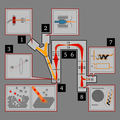 SIMS instrument scheme 600x600


Ad. Transform your health with W8MD Weight Loss, Sleep & MedSpa

Tired of being overweight?
Special offer:
Budget GLP-1 weight loss medications
- Semaglutide starting from $29.99/week and up with insurance for visit of $59.99 and up per week self pay.
- Tirzepatide starting from $45.00/week and up (dose dependent) or $69.99/week and up self pay
✔ Same-week appointments, evenings & weekends
Learn more:
- GLP-1 weight loss clinic NYC
- W8MD's NYC medical weight loss
- W8MD Philadelphia GLP-1 shots
- Philadelphia GLP-1 injections
- Affordable GLP-1 shots NYC
|
WikiMD Medical Encyclopedia |
Medical Disclaimer: WikiMD is for informational purposes only and is not a substitute for professional medical advice. Content may be inaccurate or outdated and should not be used for diagnosis or treatment. Always consult your healthcare provider for medical decisions. Verify information with trusted sources such as CDC.gov and NIH.gov. By using this site, you agree that WikiMD is not liable for any outcomes related to its content. See full disclaimer.
Credits:Most images are courtesy of Wikimedia commons, and templates, categories Wikipedia, licensed under CC BY SA or similar.
Translate this page: - East Asian
中文,
日本,
한국어,
South Asian
हिन्दी,
தமிழ்,
తెలుగు,
Urdu,
ಕನ್ನಡ,
Southeast Asian
Indonesian,
Vietnamese,
Thai,
မြန်မာဘာသာ,
বাংলা
European
español,
Deutsch,
français,
Greek,
português do Brasil,
polski,
română,
русский,
Nederlands,
norsk,
svenska,
suomi,
Italian
Middle Eastern & African
عربى,
Turkish,
Persian,
Hebrew,
Afrikaans,
isiZulu,
Kiswahili,
Other
Bulgarian,
Hungarian,
Czech,
Swedish,
മലയാളം,
मराठी,
ਪੰਜਾਬੀ,
ગુજરાતી,
Portuguese,
Ukrainian
