Mink
Mink are small, carnivorous mammals belonging to the family Mustelidae, which also includes otters, badgers, weasels, and ferrets. There are two extant species of mink: the American mink (Neovison vison) and the European mink (Mustela lutreola). Minks are known for their luxurious fur, which has been a major driver of the mink farming industry. However, this industry has also led to significant ethical and environmental concerns.
Description[edit]
Minks have elongated bodies, short legs, and partially webbed feet, which make them excellent swimmers. They typically have dark brown fur, although color variations can occur, especially in farmed minks. Minks are solitary animals, with territories that they mark using scent glands. They are primarily nocturnal and are known for their agility both in water and on land.
Habitat and Distribution[edit]
The American mink is native to North America, while the European mink is found in Europe. The American mink has been introduced to other parts of the world, including Europe, where it has become an invasive species that threatens the native European mink populations. Minks live near water bodies, such as rivers, lakes, and marshes, where they can find their prey.
Diet[edit]
Minks are carnivorous, feeding on a diet that includes fish, frogs, birds, and small mammals. Their diet varies depending on the availability of prey in their habitat. Minks use their sharp teeth and agility to catch and kill their prey.
Reproduction[edit]
Minks breed once a year, with the breeding season occurring in the spring. After a gestation period of about 40 to 75 days, the female gives birth to a litter of 3 to 6 kits. The kits are born blind and helpless, relying on their mother for food and protection until they are able to fend for themselves.
Conservation[edit]
The European mink is considered critically endangered, with habitat loss, pollution, and competition from the introduced American mink being the primary threats to its survival. Conservation efforts are focused on habitat restoration and controlling the population of American minks in Europe.
Mink Farming and Ethical Concerns[edit]
Mink farming is a controversial practice, with animals being raised in captivity for their fur. The conditions in some mink farms have raised significant animal welfare concerns, including issues related to the small size of cages, stress, and disease. Additionally, mink farms have been identified as potential sources of zoonotic diseases, including COVID-19.
Conclusion[edit]
Minks are fascinating creatures with a significant impact on both ecosystems and human industries. While they play a vital role in their natural habitats, the interaction between minks and humans, particularly through the fur industry and the introduction of species to non-native habitats, has led to complex conservation and ethical challenges.
This mustelid-related article is a stub. You can help WikiMD by expanding it.
Mink gallery[edit]
-
 American Mink
 -
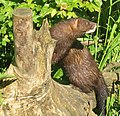 European Mink
 -
 Birgit Ridderstedt 1984
 -
 Mink with crayfish at Wascana Lake in Regina, Saskatchewan
 -
 Mink in the snow


Ad. Transform your life with W8MD's
GLP-1 weight loss injections special from $29.99 with insurance
|
WikiMD Medical Encyclopedia |
Medical Disclaimer: WikiMD is for informational purposes only and is not a substitute for professional medical advice. Content may be inaccurate or outdated and should not be used for diagnosis or treatment. Always consult your healthcare provider for medical decisions. Verify information with trusted sources such as CDC.gov and NIH.gov. By using this site, you agree that WikiMD is not liable for any outcomes related to its content. See full disclaimer.
Credits:Most images are courtesy of Wikimedia commons, and templates, categories Wikipedia, licensed under CC BY SA or similar.
Translate this page: - East Asian
中文,
日本,
한국어,
South Asian
हिन्दी,
தமிழ்,
తెలుగు,
Urdu,
ಕನ್ನಡ,
Southeast Asian
Indonesian,
Vietnamese,
Thai,
မြန်မာဘာသာ,
বাংলা
European
español,
Deutsch,
français,
Greek,
português do Brasil,
polski,
română,
русский,
Nederlands,
norsk,
svenska,
suomi,
Italian
Middle Eastern & African
عربى,
Turkish,
Persian,
Hebrew,
Afrikaans,
isiZulu,
Kiswahili,
Other
Bulgarian,
Hungarian,
Czech,
Swedish,
മലയാളം,
मराठी,
ਪੰਜਾਬੀ,
ગુજરાતી,
Portuguese,
Ukrainian
