Semi-empirical mass formula
Semi-empirical mass formula (SEMF), also known as the Bethe-Weizsäcker formula, is a theoretical equation used to approximate the nuclear binding energy of an atomic nucleus. It represents a significant concept in nuclear physics and nuclear chemistry, providing insight into the stability, structure, and energy characteristics of nuclei. The formula is termed "semi-empirical" because it is derived from both theoretical considerations and empirical adjustments.
Overview[edit]
The semi-empirical mass formula is based on the liquid drop model of the nucleus, which analogizes the nucleus to a drop of incompressible fluid. According to this model, the properties of the nucleus can be explained in terms of volume, surface area, Coulomb forces, asymmetry, and pairing effects. The SEMF is expressed as:
\[ B(A,Z) = a_V A - a_S A^{2/3} - a_C \frac{Z(Z-1)}{A^{1/3}} - a_A \frac{(A-2Z)^2}{A} + \delta(A,Z) \]
where:
- \(B(A,Z)\) is the nuclear binding energy,
- \(A\) is the mass number (total number of protons and neutrons),
- \(Z\) is the atomic number (number of protons),
- \(a_V\), \(a_S\), \(a_C\), and \(a_A\) are coefficients that represent the volume, surface, Coulomb, and asymmetry terms respectively,
- \(\delta(A,Z)\) is the pairing term, which accounts for the stability provided by pairs of protons and neutrons.
Terms Explained[edit]
- The volume term reflects the strong nuclear force's contribution to binding energy, proportional to the number of nucleons.
- The surface term accounts for the decrease in binding energy due to nucleons on the surface having fewer neighbors.
- The Coulomb term represents the electrostatic repulsion between protons.
- The asymmetry term accounts for the energy cost of having an excess of either protons or neutrons.
- The pairing term \(\delta(A,Z)\) varies depending on whether \(A\) and \(Z\) are odd or even, reflecting the extra stability of nuclei with even numbers of protons and/or neutrons.
Applications[edit]
The semi-empirical mass formula is used to:
- Predict the masses of unknown nuclei,
- Calculate the nuclear binding energy and thus the stability of nuclei,
- Understand the processes of nuclear fission and nuclear fusion,
- Estimate the energy released in nuclear reactions.
Limitations[edit]
While the SEMF provides a good approximation for many nuclei, it has limitations. It does not accurately predict the binding energies of nuclei far from the line of beta stability, nor does it account for the detailed shell structure of the nucleus. Advanced models and quantum mechanical calculations are required for more precise predictions.
See Also[edit]
- Nuclear physics
- Nuclear chemistry
- Liquid drop model
- Nuclear binding energy
- Nuclear fission
- Nuclear fusion

Semi-empirical mass formula gallery[edit]
-
 Liquid drop model
 -
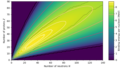 Semi-empirical mass formula
 -
 Semi-empirical mass formula discrepancy
 -
 SEMF asymmetric term
 -
 Pairing term nuclear physics


Ad. Transform your life with W8MD's
GLP-1 weight loss injections special from $29.99 with insurance
|
WikiMD Medical Encyclopedia |
Medical Disclaimer: WikiMD is for informational purposes only and is not a substitute for professional medical advice. Content may be inaccurate or outdated and should not be used for diagnosis or treatment. Always consult your healthcare provider for medical decisions. Verify information with trusted sources such as CDC.gov and NIH.gov. By using this site, you agree that WikiMD is not liable for any outcomes related to its content. See full disclaimer.
Credits:Most images are courtesy of Wikimedia commons, and templates, categories Wikipedia, licensed under CC BY SA or similar.
Translate this page: - East Asian
中文,
日本,
한국어,
South Asian
हिन्दी,
தமிழ்,
తెలుగు,
Urdu,
ಕನ್ನಡ,
Southeast Asian
Indonesian,
Vietnamese,
Thai,
မြန်မာဘာသာ,
বাংলা
European
español,
Deutsch,
français,
Greek,
português do Brasil,
polski,
română,
русский,
Nederlands,
norsk,
svenska,
suomi,
Italian
Middle Eastern & African
عربى,
Turkish,
Persian,
Hebrew,
Afrikaans,
isiZulu,
Kiswahili,
Other
Bulgarian,
Hungarian,
Czech,
Swedish,
മലയാളം,
मराठी,
ਪੰਜਾਬੀ,
ગુજરાતી,
Portuguese,
Ukrainian
