Shooting sports
Shooting sports involve competitive and recreational activities that test accuracy, precision, and speed in shooting. The equipment used varies from firearms (such as handguns, rifles, and shotguns) to airguns, including air rifles and air pistols. Shooting sports can be categorized into different disciplines, such as target shooting, clay pigeon shooting, and field shooting, each with its own set of rules and equipment.
History[edit]
The history of shooting sports goes back centuries, with early competitions often linked to training for warfare or hunting. The first recorded shooting competition took place in Eichstätt, Bavaria, in 1477. Shooting as a sport has evolved significantly since then, with the establishment of shooting clubs and societies in the 19th century, leading to the formalization of rules and competitions. The inclusion of shooting sports in the first modern Olympic Games in 1896 further solidified its status as a competitive sport.
Types of Shooting Sports[edit]
Target Shooting[edit]
Target shooting involves shooting at stationary targets, which can be made of paper, metal, or electronic displays. This discipline is further divided into sub-disciplines such as bullseye shooting, benchrest shooting, and metallic silhouette shooting. Competitions can vary based on distance, position (standing, kneeling, or prone), and type of firearm used.
Clay Pigeon Shooting[edit]
Clay pigeon shooting, also known as clay target shooting, involves shooting at flying targets known as clay pigeons or clay targets. The sport is divided into several disciplines, including Skeet shooting, Trap shooting, and Sporting Clays, each with distinct rules and target trajectories.
Field Shooting[edit]
Field shooting encompasses a range of activities conducted in natural or semi-natural environments. This includes hunting simulations such as field target and practical shooting disciplines like 3-Gun, which tests the shooter's ability to use multiple firearms (rifle, shotgun, and handgun) in a dynamic and timed environment.
Governing Bodies[edit]
The International Shooting Sport Federation (ISSF) is the leading body for the promotion and governance of target shooting sports worldwide. It oversees international competitions, including those at the Olympic Games. Other notable organizations include the International Practical Shooting Confederation (IPSC) for practical shooting, the International Defensive Pistol Association (IDPA), and the National Rifle Association (NRA) in the United States, which governs a variety of shooting disciplines within the country.
Safety and Education[edit]
Safety is paramount in shooting sports. Participants are required to undergo training and adhere to strict safety protocols to prevent accidents. This includes the proper handling, storage, and maintenance of firearms, as well as wearing protective gear such as ear protection and eye protection. Educational programs and certifications offered by various organizations aim to promote safe and responsible shooting practices.
Cultural and Social Aspects[edit]
Shooting sports have a significant cultural and social aspect, fostering community, discipline, and respect for firearms. They also contribute to physical and mental health by improving focus, hand-eye coordination, and stress relief. However, the sport also faces challenges, including debates over gun control and the environmental impact of shooting activities.

Shooting sports gallery[edit]
-
 Skeet masculin aux Jeux olympiques de 2024 - Éric Delaunay
 -
 Washington DC Girls' Rifle Team
 -
 Bullet coming from S&W
 -
 Target 223 Savage 10FP 25 shot
 -
 A typical "American" trap shoot scene
 -
 Skeet. William H. Keever, USA
 -
 USMC shooting
 -
 Trap shooting at WPFG
 -
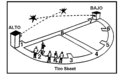 Skeet
Skeet
.jpg)


.jpg)

Ad. Transform your health with W8MD Weight Loss, Sleep & MedSpa

Tired of being overweight?
Special offer:
Budget GLP-1 weight loss medications
- Semaglutide starting from $29.99/week and up with insurance for visit of $59.99 and up per week self pay.
- Tirzepatide starting from $45.00/week and up (dose dependent) or $69.99/week and up self pay
✔ Same-week appointments, evenings & weekends
Learn more:
- GLP-1 weight loss clinic NYC
- W8MD's NYC medical weight loss
- W8MD Philadelphia GLP-1 shots
- Philadelphia GLP-1 injections
- Affordable GLP-1 shots NYC
|
WikiMD Medical Encyclopedia |
Medical Disclaimer: WikiMD is for informational purposes only and is not a substitute for professional medical advice. Content may be inaccurate or outdated and should not be used for diagnosis or treatment. Always consult your healthcare provider for medical decisions. Verify information with trusted sources such as CDC.gov and NIH.gov. By using this site, you agree that WikiMD is not liable for any outcomes related to its content. See full disclaimer.
Credits:Most images are courtesy of Wikimedia commons, and templates, categories Wikipedia, licensed under CC BY SA or similar.
Translate this page: - East Asian
中文,
日本,
한국어,
South Asian
हिन्दी,
தமிழ்,
తెలుగు,
Urdu,
ಕನ್ನಡ,
Southeast Asian
Indonesian,
Vietnamese,
Thai,
မြန်မာဘာသာ,
বাংলা
European
español,
Deutsch,
français,
Greek,
português do Brasil,
polski,
română,
русский,
Nederlands,
norsk,
svenska,
suomi,
Italian
Middle Eastern & African
عربى,
Turkish,
Persian,
Hebrew,
Afrikaans,
isiZulu,
Kiswahili,
Other
Bulgarian,
Hungarian,
Czech,
Swedish,
മലയാളം,
मराठी,
ਪੰਜਾਬੀ,
ગુજરાતી,
Portuguese,
Ukrainian
