Rebreather
Rebreather
A Rebreather is a type of breathing set that provides a breathing gas containing oxygen and recycled exhaled gas. This recycling reduces the volume of breathing gas used, making a rebreather a good tool for underwater diving and space travel.
History[edit]
The concept of re-breathing has been around for several centuries. The first rebreather, designed by Henry Fleuss in 1878, was used to help divers stay underwater for longer periods of time.
Types of Rebreathers[edit]
There are three main types of rebreathers: oxygen rebreather, semi-closed circuit rebreather, and closed circuit rebreather.
Oxygen Rebreather[edit]
An oxygen rebreather is a rebreather that uses pure oxygen as the only source of oxygen.
Semi-Closed Circuit Rebreather[edit]
A semi-closed circuit rebreather uses a gas mix of oxygen and an inert gas, such as nitrogen or helium.
Closed Circuit Rebreather[edit]
A closed circuit rebreather uses a gas mix that is typically one third oxygen and two thirds inert gas.
Advantages and Disadvantages[edit]
Rebreathers have several advantages over other breathing sets. They are more gas efficient, produce no bubbles, and allow for longer dive times. However, they are also more complex and expensive.
See Also[edit]
 | |
|---|---|
 |
 |
-
 Plongee Recycleur Inspiration
 -
 Physiological effects of carbon dioxide concentration and exposure period
 -
 Rebreather architecture
 -
 Self-contained gas mask
 -
 2009 Donetsk
 -
 Draeger Ray DSV and breathing hoses
 -
 Aa proto1
 -
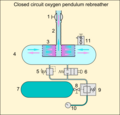 Oxygen CCR pendulum schematic
 -
 Oxygen CCR loop schematic
 -
 Agnes Milowka by J Axford


Ad. Transform your life with W8MD's
GLP-1 weight loss injections special from $29.99 with insurance
|
WikiMD Medical Encyclopedia |
Medical Disclaimer: WikiMD is for informational purposes only and is not a substitute for professional medical advice. Content may be inaccurate or outdated and should not be used for diagnosis or treatment. Always consult your healthcare provider for medical decisions. Verify information with trusted sources such as CDC.gov and NIH.gov. By using this site, you agree that WikiMD is not liable for any outcomes related to its content. See full disclaimer.
Credits:Most images are courtesy of Wikimedia commons, and templates, categories Wikipedia, licensed under CC BY SA or similar.
Translate this page: - East Asian
中文,
日本,
한국어,
South Asian
हिन्दी,
தமிழ்,
తెలుగు,
Urdu,
ಕನ್ನಡ,
Southeast Asian
Indonesian,
Vietnamese,
Thai,
မြန်မာဘာသာ,
বাংলা
European
español,
Deutsch,
français,
Greek,
português do Brasil,
polski,
română,
русский,
Nederlands,
norsk,
svenska,
suomi,
Italian
Middle Eastern & African
عربى,
Turkish,
Persian,
Hebrew,
Afrikaans,
isiZulu,
Kiswahili,
Other
Bulgarian,
Hungarian,
Czech,
Swedish,
മലയാളം,
मराठी,
ਪੰਜਾਬੀ,
ગુજરાતી,
Portuguese,
Ukrainian
