Crystal structure
Crystal structure is the ordered arrangement of atoms, ions, or molecules in a crystalline material. Ordered structures occur from the intrinsic nature of the constituent particles to form symmetric patterns that repeat along the principal directions of three-dimensional space in matter.
The smallest group of particles in the material that constitutes this repeating pattern is the unit cell of the structure. The unit cell completely reflects the symmetry and structure of the entire crystal, which is built up by repetitive translation of the unit cell along its principal axes. The translation vectors define a parallelpiped, the shape of which is determined by the magnitudes of the vectors and the angles between them.
Types of Crystal Structures[edit]
There are many types of crystal structures in nature, such as body-centered cubic (BCC), face-centered cubic (FCC), and hexagonal close-packed (HCP). These structures are determined by factors such as the size and number of atoms in the unit cell and the conditions under which the material was formed.
Body-centered cubic (BCC)[edit]
In a BCC arrangement of atoms, the unit cell consists of eight atoms at the corners of a cube and one atom at the center of the cube. It is referred to as "body-centered" because the central atom is located at the body center of the unit cell.
Face-centered cubic (FCC)[edit]
In an FCC arrangement, the unit cell consists of eight atoms at the corners of a cube and one atom centered on each of the cube's six faces. It is referred to as "face-centered" because the additional atoms are located at the center of each face of the unit cell.
Hexagonal close-packed (HCP)[edit]
In an HCP arrangement, the unit cell consists of 12 atoms that form a regular hexagon around a central atom. With an additional atom below and above the central atom, the unit cell contains a total of 14 atoms.
See Also[edit]
References[edit]
<references />
 | |
|---|---|
 |
 |
Crystal structure gallery[edit]
-
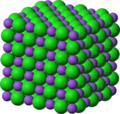 Sodium chloride 3D ionic
 -
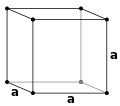 Lattice simple cubic
 -
 Lattice body centered cubic
 -
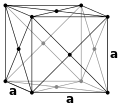 Lattice face centered cubic
 -
 Miller Indices Cubes
 -
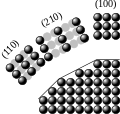 Cristal densité surface
 -
 Triclinic
 -
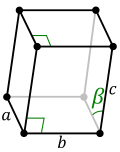 Monoclinic
 -
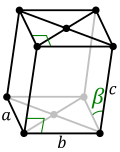 Base-centered monoclinic
 -
 Orthorhombic


Ad. Transform your health with W8MD Weight Loss, Sleep & MedSpa

Tired of being overweight?
Special offer:
Budget GLP-1 weight loss medications
- Semaglutide starting from $29.99/week and up with insurance for visit of $59.99 and up per week self pay.
- Tirzepatide starting from $45.00/week and up (dose dependent) or $69.99/week and up self pay
✔ Same-week appointments, evenings & weekends
Learn more:
- GLP-1 weight loss clinic NYC
- W8MD's NYC medical weight loss
- W8MD Philadelphia GLP-1 shots
- Philadelphia GLP-1 injections
- Affordable GLP-1 shots NYC
|
WikiMD Medical Encyclopedia |
Medical Disclaimer: WikiMD is for informational purposes only and is not a substitute for professional medical advice. Content may be inaccurate or outdated and should not be used for diagnosis or treatment. Always consult your healthcare provider for medical decisions. Verify information with trusted sources such as CDC.gov and NIH.gov. By using this site, you agree that WikiMD is not liable for any outcomes related to its content. See full disclaimer.
Credits:Most images are courtesy of Wikimedia commons, and templates, categories Wikipedia, licensed under CC BY SA or similar.
Translate this page: - East Asian
中文,
日本,
한국어,
South Asian
हिन्दी,
தமிழ்,
తెలుగు,
Urdu,
ಕನ್ನಡ,
Southeast Asian
Indonesian,
Vietnamese,
Thai,
မြန်မာဘာသာ,
বাংলা
European
español,
Deutsch,
français,
Greek,
português do Brasil,
polski,
română,
русский,
Nederlands,
norsk,
svenska,
suomi,
Italian
Middle Eastern & African
عربى,
Turkish,
Persian,
Hebrew,
Afrikaans,
isiZulu,
Kiswahili,
Other
Bulgarian,
Hungarian,
Czech,
Swedish,
മലയാളം,
मराठी,
ਪੰਜਾਬੀ,
ગુજરાતી,
Portuguese,
Ukrainian
