Scott Carpenter
Scott Carpenter (May 1, 1925 – October 10, 2013) was an American test pilot, astronaut, and aquanaut. He was one of the original seven astronauts selected for NASA's Project Mercury in April 1959. Carpenter was the second American (after John Glenn) to orbit the Earth and the fourth American in space.
Early life and education[edit]
Carpenter was born in Boulder, Colorado, and attended the University of Colorado Boulder, where he studied Aeronautical Engineering.
NASA career[edit]
Carpenter was selected as one of the original seven astronauts for Project Mercury in 1959. His spacecraft, the Aurora 7, was launched on May 24, 1962. During the flight, Carpenter orbited the Earth three times.
Post-NASA career[edit]
After leaving NASA, Carpenter explored undersea environments as an aquanaut in the Navy's SEALAB program. He also wrote two novels and contributed to the design of the Navy's Mystic class deep-submergence rescue vehicle.
Death[edit]
Carpenter died on October 10, 2013, in Denver, Colorado, at the age of 88.
Legacy[edit]
Carpenter's contributions to space and undersea exploration have been recognized with numerous awards and honors. He is remembered as a pioneer of early space travel and for his work in promoting the exploration and understanding of the world's oceans.
See also[edit]
References[edit]
<references />
.jpg)
-
 Malcolm Scott Carpenter
 -
 Aurora 7 patch
 -
 Lockheed P2V-7 Neptune in flight near NAS Patuxent River in 1954
 -
 The Mercury 7
 -
 Visit of Scott Carpenter and his family to the White House
 -
 Carpenter suiting up
 -
 Carpenter Aurora 7
 -
 Mercury-7 landing
 -
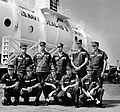 Sealab II
 -
 Scott Carpenter in SEALAB II


.jpg)


Ad. Transform your life with W8MD's
GLP-1 weight loss injections special from $29.99 with insurance
|
WikiMD Medical Encyclopedia |
Medical Disclaimer: WikiMD is for informational purposes only and is not a substitute for professional medical advice. Content may be inaccurate or outdated and should not be used for diagnosis or treatment. Always consult your healthcare provider for medical decisions. Verify information with trusted sources such as CDC.gov and NIH.gov. By using this site, you agree that WikiMD is not liable for any outcomes related to its content. See full disclaimer.
Credits:Most images are courtesy of Wikimedia commons, and templates, categories Wikipedia, licensed under CC BY SA or similar.
Translate this page: - East Asian
中文,
日本,
한국어,
South Asian
हिन्दी,
தமிழ்,
తెలుగు,
Urdu,
ಕನ್ನಡ,
Southeast Asian
Indonesian,
Vietnamese,
Thai,
မြန်မာဘာသာ,
বাংলা
European
español,
Deutsch,
français,
Greek,
português do Brasil,
polski,
română,
русский,
Nederlands,
norsk,
svenska,
suomi,
Italian
Middle Eastern & African
عربى,
Turkish,
Persian,
Hebrew,
Afrikaans,
isiZulu,
Kiswahili,
Other
Bulgarian,
Hungarian,
Czech,
Swedish,
മലയാളം,
मराठी,
ਪੰਜਾਬੀ,
ગુજરાતી,
Portuguese,
Ukrainian
