Aminolevulinic acid synthase
Aminolevulinic Acid Synthase
Aminolevulinic acid synthase (ALAS) is a crucial enzyme in the biosynthesis of heme, the iron-containing prosthetic group that forms an essential component of various hemoproteins, including hemoglobin, myoglobin, and cytochromes. ALAS catalyzes the first step in the heme biosynthetic pathway, which is the condensation of glycine and succinyl-CoA to form aminolevulinic acid (ALA).
Structure and Function[edit]
ALAS is a mitochondrial enzyme that exists in two isoforms in humans: ALAS1 and ALAS2. ALAS1 is ubiquitously expressed in all tissues, while ALAS2 is erythroid-specific, being expressed primarily in the bone marrow where it plays a critical role in erythropoiesis.
The enzyme is a pyridoxal phosphate (PLP)-dependent enzyme, which means it requires the cofactor pyridoxal phosphate, a form of vitamin B6, to function. The reaction catalyzed by ALAS is as follows:
- Glycine + Succinyl-CoA → Aminolevulinic acid + CoA + CO₂
This reaction is the rate-limiting step in the heme biosynthetic pathway, making ALAS a key regulatory point in heme production.
Regulation[edit]
The activity of ALAS is tightly regulated at multiple levels, including transcriptional, translational, and post-translational mechanisms. ALAS1 is regulated by feedback inhibition from heme, which decreases its transcription and activity. ALAS2, on the other hand, is regulated by iron availability, as it contains an iron-responsive element (IRE) in its mRNA that modulates its translation in response to iron levels.
Clinical Significance[edit]
Mutations in the ALAS2 gene can lead to X-linked sideroblastic anemia, a condition characterized by the presence of ringed sideroblasts in the bone marrow and impaired heme synthesis. This results in microcytic, hypochromic anemia.
In addition, ALAS is a target for certain drugs and therapies. For example, 5-aminolevulinic acid (5-ALA) is used in photodynamic therapy for cancer treatment, as it accumulates preferentially in cancer cells and can be activated by light to produce cytotoxic reactive oxygen species.
Also see[edit]

Aminolevulinic acid synthase gallery[edit]
-
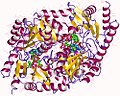 2bwo
2bwo -
 ALAS Reaction Mechanism Image
 -
 Heme synth step1
 -
 Heme synthesis


Ad. Transform your health with W8MD Weight Loss, Sleep & MedSpa

Tired of being overweight?
Special offer:
Budget GLP-1 weight loss medications
- Semaglutide starting from $29.99/week and up with insurance for visit of $59.99 and up per week self pay.
- Tirzepatide starting from $45.00/week and up (dose dependent) or $69.99/week and up self pay
✔ Same-week appointments, evenings & weekends
Learn more:
- GLP-1 weight loss clinic NYC
- W8MD's NYC medical weight loss
- W8MD Philadelphia GLP-1 shots
- Philadelphia GLP-1 injections
- Affordable GLP-1 shots NYC
|
WikiMD Medical Encyclopedia |
Medical Disclaimer: WikiMD is for informational purposes only and is not a substitute for professional medical advice. Content may be inaccurate or outdated and should not be used for diagnosis or treatment. Always consult your healthcare provider for medical decisions. Verify information with trusted sources such as CDC.gov and NIH.gov. By using this site, you agree that WikiMD is not liable for any outcomes related to its content. See full disclaimer.
Credits:Most images are courtesy of Wikimedia commons, and templates, categories Wikipedia, licensed under CC BY SA or similar.
Translate this page: - East Asian
中文,
日本,
한국어,
South Asian
हिन्दी,
தமிழ்,
తెలుగు,
Urdu,
ಕನ್ನಡ,
Southeast Asian
Indonesian,
Vietnamese,
Thai,
မြန်မာဘာသာ,
বাংলা
European
español,
Deutsch,
français,
Greek,
português do Brasil,
polski,
română,
русский,
Nederlands,
norsk,
svenska,
suomi,
Italian
Middle Eastern & African
عربى,
Turkish,
Persian,
Hebrew,
Afrikaans,
isiZulu,
Kiswahili,
Other
Bulgarian,
Hungarian,
Czech,
Swedish,
മലയാളം,
मराठी,
ਪੰਜਾਬੀ,
ગુજરાતી,
Portuguese,
Ukrainian
