List of chemical element name etymologies
List of Chemical Element Name Etymologies
Introduction[edit]
The names of chemical elements are derived from a variety of sources, including mythology, minerals, places, and scientists. Understanding the etymology of these names provides insight into the history of chemistry and the cultural influences that have shaped the periodic table.
Mythological Origins[edit]
Several elements are named after mythological figures or deities. For example, tantalum is named after Tantalus, a character from Greek mythology, due to the element's inability to absorb acid, reminiscent of Tantalus's eternal punishment of being unable to drink water.
Mineral and Substance Origins[edit]
Many elements are named after the minerals or substances from which they were first isolated. For instance, barium is named after the mineral barite, which is derived from the Greek word "barys," meaning heavy.
Geographical Origins[edit]
Some elements are named after places where they were discovered or first isolated. Polonium is named after Poland, the homeland of Marie Curie, who discovered the element.
Scientist and Discoverer Origins[edit]
A number of elements are named in honor of scientists who made significant contributions to the field of chemistry. Curium is named after Marie and Pierre Curie, pioneers in the study of radioactivity.
Astronomical Origins[edit]
Certain elements are named after celestial bodies. Helium is named after the Sun (Helios in Greek) because it was first detected in the solar spectrum.
Etymology of Selected Elements[edit]
Hydrogen[edit]
The name "hydrogen" comes from the Greek words "hydro" and "genes," meaning "water-forming." It was named by Antoine Lavoisier because it forms water when burned in air.
Oxygen[edit]
Oxygen's name is derived from the Greek words "oxys" and "genes," meaning "acid-forming," as it was originally thought to be a component of all acids.
Lithium[edit]
Lithium is named after "lithos," the Greek word for stone, as it was discovered in a mineral.
Neon[edit]
The name "neon" comes from the Greek word "neos," meaning new, as it was a newly discovered element at the time.
Uranium[edit]
Uranium is named after the planet Uranus, which had been discovered just eight years before the element.
Conclusion[edit]
The etymology of chemical element names reflects a rich tapestry of history, culture, and scientific discovery. Each name tells a story about the element's discovery, its properties, or the people and places associated with it.
| Chemical elements | ||||||||
|---|---|---|---|---|---|---|---|---|
This Chemical elements related article is a stub.
|
-
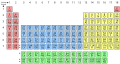 Simple Periodic Table Chart blocks

Ad. Transform your life with W8MD's
GLP-1 weight loss injections special from $29.99 with insurance
|
WikiMD Medical Encyclopedia |
Medical Disclaimer: WikiMD is for informational purposes only and is not a substitute for professional medical advice. Content may be inaccurate or outdated and should not be used for diagnosis or treatment. Always consult your healthcare provider for medical decisions. Verify information with trusted sources such as CDC.gov and NIH.gov. By using this site, you agree that WikiMD is not liable for any outcomes related to its content. See full disclaimer.
Credits:Most images are courtesy of Wikimedia commons, and templates, categories Wikipedia, licensed under CC BY SA or similar.
Translate this page: - East Asian
中文,
日本,
한국어,
South Asian
हिन्दी,
தமிழ்,
తెలుగు,
Urdu,
ಕನ್ನಡ,
Southeast Asian
Indonesian,
Vietnamese,
Thai,
မြန်မာဘာသာ,
বাংলা
European
español,
Deutsch,
français,
Greek,
português do Brasil,
polski,
română,
русский,
Nederlands,
norsk,
svenska,
suomi,
Italian
Middle Eastern & African
عربى,
Turkish,
Persian,
Hebrew,
Afrikaans,
isiZulu,
Kiswahili,
Other
Bulgarian,
Hungarian,
Czech,
Swedish,
മലയാളം,
मराठी,
ਪੰਜਾਬੀ,
ગુજરાતી,
Portuguese,
Ukrainian
