Seal hunting

Seal hunting, or sealing, is the practice of hunting seals for their meat, oil, blubber, and fur. This activity has been a part of human culture since prehistoric times. Historically, seal hunting was an important subsistence and economic activity in certain communities, particularly those in the Arctic and Antarctic regions. Today, seal hunting is subject to international debate and regulation due to concerns over animal welfare and the conservation status of certain seal species.
History[edit]
Seal hunting has ancient origins, with archaeological evidence indicating its practice by indigenous peoples of the Arctic thousands of years ago. These communities relied on seals not only for food but also for materials like fur for clothing and oil for fuel. In the Middle Ages, European explorers and settlers in the New World engaged in seal hunting for trade, utilizing the fur in the fashion industry and the oil for lamps.
Methods[edit]
Various methods are used in seal hunting, including the use of firearms, clubs, or harpoons. The method often depends on the specific regulations of the country in which the hunting takes place, as well as the species being hunted. Traditional methods, such as the use of kayaks and harpoons, are still practiced by some indigenous communities in a manner that is considered sustainable and integral to their cultural heritage.
Controversy and Regulation[edit]
Seal hunting has been the subject of international controversy, particularly concerning the welfare of the animals and the sustainability of certain practices. High-profile campaigns by animal rights organizations have led to increased public scrutiny and the implementation of regulations and bans in several countries. The European Union, for example, has banned the import of seal products, with exceptions for products resulting from traditional hunting by indigenous peoples.
The International Whaling Commission (IWC) and the Convention on International Trade in Endangered Species of Wild Fauna and Flora (CITES) are among the international bodies that regulate the hunting and trade of seals to ensure the conservation of species under threat.
Economic and Cultural Significance[edit]
In some regions, seal hunting remains an important economic activity, providing a source of income and resources for local communities. It is also of cultural significance to indigenous peoples, for whom seal hunting is a tradition that connects them to their ancestors and the natural world.
Current Status[edit]
The practice of seal hunting varies widely around the world, with some countries having strict regulations or complete bans, while others continue to support it as a sustainable practice under certain conditions. The debate over seal hunting is ongoing, with animal welfare advocates and indigenous communities often having differing perspectives on its ethical and cultural implications.
.png)
Seal_hunting[edit]
-
 Killing fur seals, St Paul Island
 -
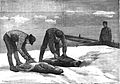 Seal-skinning on the floes
 -
 Eskimo Seal Hunting
 -
 Reimerswaal ¿ Zeehondenjacht
 -
 Cook-1777
 -
 Sealhunt 550
 -
 USS Bear (AG-29) Antarctica c1939
 -
 Choris, Saint Paul


_Antarctica_c1939.jpg)

Ad. Transform your health with W8MD Weight Loss, Sleep & MedSpa

Tired of being overweight?
Special offer:
Budget GLP-1 weight loss medications
- Semaglutide starting from $29.99/week and up with insurance for visit of $59.99 and up per week self pay.
- Tirzepatide starting from $45.00/week and up (dose dependent) or $69.99/week and up self pay
✔ Same-week appointments, evenings & weekends
Learn more:
- GLP-1 weight loss clinic NYC
- W8MD's NYC medical weight loss
- W8MD Philadelphia GLP-1 shots
- Philadelphia GLP-1 injections
- Affordable GLP-1 shots NYC
|
WikiMD Medical Encyclopedia |
Medical Disclaimer: WikiMD is for informational purposes only and is not a substitute for professional medical advice. Content may be inaccurate or outdated and should not be used for diagnosis or treatment. Always consult your healthcare provider for medical decisions. Verify information with trusted sources such as CDC.gov and NIH.gov. By using this site, you agree that WikiMD is not liable for any outcomes related to its content. See full disclaimer.
Credits:Most images are courtesy of Wikimedia commons, and templates, categories Wikipedia, licensed under CC BY SA or similar.
Translate this page: - East Asian
中文,
日本,
한국어,
South Asian
हिन्दी,
தமிழ்,
తెలుగు,
Urdu,
ಕನ್ನಡ,
Southeast Asian
Indonesian,
Vietnamese,
Thai,
မြန်မာဘာသာ,
বাংলা
European
español,
Deutsch,
français,
Greek,
português do Brasil,
polski,
română,
русский,
Nederlands,
norsk,
svenska,
suomi,
Italian
Middle Eastern & African
عربى,
Turkish,
Persian,
Hebrew,
Afrikaans,
isiZulu,
Kiswahili,
Other
Bulgarian,
Hungarian,
Czech,
Swedish,
മലയാളം,
मराठी,
ਪੰਜਾਬੀ,
ગુજરાતી,
Portuguese,
Ukrainian
