List of human endocrine organs and actions
List of Human Endocrine Organs and Actions[edit]
The human endocrine system is a complex network of glands, hormones, and receptors that play a crucial role in maintaining homeostasis in the body. This article provides a comprehensive list of the human endocrine organs and their actions.
Hypothalamus[edit]
The hypothalamus is a small region of the brain that links the nervous system to the endocrine system via the pituitary gland. It plays a crucial role in maintaining the body's internal balance (homeostasis) by controlling body temperature, thirst, hunger, and other homeostatic systems, and is involved in sleep and emotional activity.
Pituitary Gland[edit]
The pituitary gland, also known as the hypophysis, is a small pea-sized gland located at the base of the brain. It is often referred to as the "master gland" because it controls the function of most other endocrine glands. The pituitary gland secretes a variety of hormones that regulate various bodily functions including growth, reproduction, and metabolic processes.
Thyroid Gland[edit]
The thyroid gland is a butterfly-shaped organ located in the neck. It produces thyroid hormones, which regulate the body's metabolic rate as well as heart and digestive function, muscle control, brain development, mood, and bone maintenance.
Parathyroid Glands[edit]
The parathyroid glands are four tiny glands located in the neck behind the thyroid gland. They produce parathyroid hormone, which regulates the body's calcium and phosphate levels.
Adrenal Glands[edit]
The adrenal glands are small glands located on top of each kidney. They produce hormones that help regulate your metabolism, immune system, blood pressure, response to stress, and other essential functions.
Pancreas[edit]
The pancreas is a gland located in the abdomen. It has both endocrine and exocrine functions. The endocrine function involves the secretion of insulin (which decreases blood glucose levels) and glucagon (which increases blood glucose levels).
Ovaries[edit]
In females, the ovaries are the reproductive glands that produce eggs for fertilization. They also produce the female sex hormones estrogen and progesterone.
Testes[edit]
In males, the testes are the reproductive glands that produce sperm and the male sex hormone testosterone.
See Also[edit]
References[edit]
<references />

List of human endocrine organs and actions[edit]
-
 Endocrine central nervous system
 -
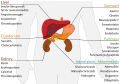 Endocrine alimentary system
 -
 Endocrine reproductive system
 -
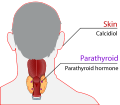 Endocrine calcium regulation
 -
 Calcium regulation
 -
 Endocrine miscellaneous


Ad. Transform your health with W8MD Weight Loss, Sleep & MedSpa

Tired of being overweight?
Special offer:
Budget GLP-1 weight loss medications
- Semaglutide starting from $29.99/week and up with insurance for visit of $59.99 and up per week self pay.
- Tirzepatide starting from $45.00/week and up (dose dependent) or $69.99/week and up self pay
✔ Same-week appointments, evenings & weekends
Learn more:
- GLP-1 weight loss clinic NYC
- W8MD's NYC medical weight loss
- W8MD Philadelphia GLP-1 shots
- Philadelphia GLP-1 injections
- Affordable GLP-1 shots NYC
|
WikiMD Medical Encyclopedia |
Medical Disclaimer: WikiMD is for informational purposes only and is not a substitute for professional medical advice. Content may be inaccurate or outdated and should not be used for diagnosis or treatment. Always consult your healthcare provider for medical decisions. Verify information with trusted sources such as CDC.gov and NIH.gov. By using this site, you agree that WikiMD is not liable for any outcomes related to its content. See full disclaimer.
Credits:Most images are courtesy of Wikimedia commons, and templates, categories Wikipedia, licensed under CC BY SA or similar.
Translate this page: - East Asian
中文,
日本,
한국어,
South Asian
हिन्दी,
தமிழ்,
తెలుగు,
Urdu,
ಕನ್ನಡ,
Southeast Asian
Indonesian,
Vietnamese,
Thai,
မြန်မာဘာသာ,
বাংলা
European
español,
Deutsch,
français,
Greek,
português do Brasil,
polski,
română,
русский,
Nederlands,
norsk,
svenska,
suomi,
Italian
Middle Eastern & African
عربى,
Turkish,
Persian,
Hebrew,
Afrikaans,
isiZulu,
Kiswahili,
Other
Bulgarian,
Hungarian,
Czech,
Swedish,
മലയാളം,
मराठी,
ਪੰਜਾਬੀ,
ગુજરાતી,
Portuguese,
Ukrainian
