Reciprocity Treaty of 1875
Reciprocity Treaty of 1875
The Reciprocity Treaty of 1875 was a free trade agreement between the Kingdom of Hawaii and the United States. The treaty was signed on January 30, 1875, and led to significant economic and demographic changes in Hawaii.
Background[edit]
In the mid-19th century, the Kingdom of Hawaii was an independent nation with a growing economy based on the export of sugar and other agricultural products. The United States, on the other hand, was a rapidly industrializing nation with a high demand for raw materials and a desire to expand its influence in the Pacific.
Negotiation and Terms[edit]
The treaty was negotiated by Elisha Hunt Allen, the Hawaiian Minister to the United States, and Hamilton Fish, the U.S. Secretary of State. Under the terms of the treaty, the United States agreed to admit Hawaiian sugar and other agricultural products duty-free. In return, Hawaii granted the United States exclusive rights to enter and establish a coaling station in Pearl Harbor.
Impact[edit]
The Reciprocity Treaty of 1875 had a profound impact on Hawaii's economy and society. The treaty led to a boom in the sugar industry, attracting investment and immigration, particularly from China and Japan. This influx of foreign laborers dramatically altered the demographic makeup of the islands.
However, the treaty also made Hawaii economically dependent on the United States. This dependence, coupled with the strategic importance of Pearl Harbor, set the stage for the eventual overthrow of the Hawaiian monarchy and the annexation of Hawaii by the United States.
Termination and Aftermath[edit]
The Reciprocity Treaty of 1875 was initially set to last for seven years, but it was extended in 1884 for another seven years. However, the treaty was effectively terminated in 1890 when the McKinley Tariff Act removed the duty-free status of Hawaiian sugar, leading to a severe economic downturn in Hawaii.
The end of the treaty and the economic crisis that followed were among the factors that led to the overthrow of the Hawaiian monarchy in 1893 and the annexation of Hawaii by the United States in 1898.
See Also[edit]


Reciprocity Treaty of 1875[edit]
-
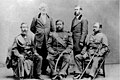 Kalakaua and Reciprocity Commission
.jpg)
Ad. Transform your health with W8MD Weight Loss, Sleep & MedSpa

Tired of being overweight?
Special offer:
Budget GLP-1 weight loss medications
- Semaglutide starting from $29.99/week and up with insurance for visit of $59.99 and up per week self pay.
- Tirzepatide starting from $45.00/week and up (dose dependent) or $69.99/week and up self pay
✔ Same-week appointments, evenings & weekends
Learn more:
Start your transformation today with W8MD weight loss centers.
|
WikiMD Medical Encyclopedia |
Medical Disclaimer: WikiMD is for informational purposes only and is not a substitute for professional medical advice. Content may be inaccurate or outdated and should not be used for diagnosis or treatment. Always consult your healthcare provider for medical decisions. Verify information with trusted sources such as CDC.gov and NIH.gov. By using this site, you agree that WikiMD is not liable for any outcomes related to its content. See full disclaimer.
Credits:Most images are courtesy of Wikimedia commons, and templates, categories Wikipedia, licensed under CC BY SA or similar.
Translate this page: - East Asian
中文,
日本,
한국어,
South Asian
हिन्दी,
தமிழ்,
తెలుగు,
Urdu,
ಕನ್ನಡ,
Southeast Asian
Indonesian,
Vietnamese,
Thai,
မြန်မာဘာသာ,
বাংলা
European
español,
Deutsch,
français,
Greek,
português do Brasil,
polski,
română,
русский,
Nederlands,
norsk,
svenska,
suomi,
Italian
Middle Eastern & African
عربى,
Turkish,
Persian,
Hebrew,
Afrikaans,
isiZulu,
Kiswahili,
Other
Bulgarian,
Hungarian,
Czech,
Swedish,
മലയാളം,
मराठी,
ਪੰਜਾਬੀ,
ગુજરાતી,
Portuguese,
Ukrainian
