Cocktail bun
Cocktail Bun[edit]
| [[File:|frameless|alt=]] | |
| Alternative names | |
| Type | |
| Course | |
| Place of origin | Hong Kong |
| Region or state | |
| Associated national cuisine | |
| Created by | |
| Invented | |
| Cooking time | minutes to minutes |
| Serving temperature | |
| Main ingredients | Bread, butter, sugar, coconut filling |
| Ingredients generally used | |
| Variations | |
| Food energy | kcal |
| Nutritional value | Protein: g, Fat: g, Carbohydrate: g |
| Glycemic index | |
| Similar dishes | |
| Other information | |
| Website | [ Official website] |
The Cocktail Bun is a popular sweet pastry that originated in Hong Kong. It is a type of bun that is typically filled with a sweet coconut filling and topped with a buttery crust. Despite its name, the Cocktail Bun does not contain any alcohol.
History[edit]
The Cocktail Bun has a long history in Hong Kong and is considered a classic local delicacy. It is believed to have been introduced during the colonial era when British influences were prominent in the region. The bun's name is said to have been inspired by the British cocktail parties that were popular at the time.
Ingredients and Preparation[edit]
The main ingredients used in making Cocktail Buns include bread dough, butter, sugar, and a sweet coconut filling. The bread dough is typically soft and slightly sweet, providing a perfect base for the filling. The coconut filling is made by combining shredded coconut with sugar and sometimes additional flavorings such as vanilla or pandan.
To prepare Cocktail Buns, the bread dough is first shaped into small buns and then filled with the coconut mixture. The buns are then topped with a layer of buttery crust, which adds a rich and crispy texture to the pastry. After baking, the buns are golden brown and have a fragrant aroma.
Serving and Variations[edit]
Cocktail Buns are commonly enjoyed as a breakfast or snack item in Hong Kong. They are often served warm and can be found in bakeries and dim sum restaurants throughout the city. Some variations of the Cocktail Bun may include additional fillings such as red bean paste or custard.
Cultural Significance[edit]
The Cocktail Bun holds a special place in Hong Kong's culinary culture. It is considered a nostalgic treat for many locals and is often associated with childhood memories. The bun's unique combination of flavors and textures has made it a beloved pastry among both locals and visitors to Hong Kong.
See Also[edit]
References[edit]
-
 Cocktail bun with a fancy design
 -
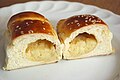 Cross-section of a fancy cocktail bun


Cocktail_bun[edit]
-
Cocktail Bun fancy
-
Cocktail Bun fancy cross-section
Ad. Transform your health with W8MD Weight Loss, Sleep & MedSpa

Tired of being overweight?
Special offer:
Budget GLP-1 weight loss medications
- Semaglutide starting from $29.99/week and up with insurance for visit of $59.99 and up per week self pay.
- Tirzepatide starting from $45.00/week and up (dose dependent) or $69.99/week and up self pay
✔ Same-week appointments, evenings & weekends
Learn more:
- GLP-1 weight loss clinic NYC
- W8MD's NYC medical weight loss
- W8MD Philadelphia GLP-1 shots
- Philadelphia GLP-1 injections
- Affordable GLP-1 shots NYC
|
WikiMD Medical Encyclopedia |
Medical Disclaimer: WikiMD is for informational purposes only and is not a substitute for professional medical advice. Content may be inaccurate or outdated and should not be used for diagnosis or treatment. Always consult your healthcare provider for medical decisions. Verify information with trusted sources such as CDC.gov and NIH.gov. By using this site, you agree that WikiMD is not liable for any outcomes related to its content. See full disclaimer.
Credits:Most images are courtesy of Wikimedia commons, and templates, categories Wikipedia, licensed under CC BY SA or similar.
Translate this page: - East Asian
中文,
日本,
한국어,
South Asian
हिन्दी,
தமிழ்,
తెలుగు,
Urdu,
ಕನ್ನಡ,
Southeast Asian
Indonesian,
Vietnamese,
Thai,
မြန်မာဘာသာ,
বাংলা
European
español,
Deutsch,
français,
Greek,
português do Brasil,
polski,
română,
русский,
Nederlands,
norsk,
svenska,
suomi,
Italian
Middle Eastern & African
عربى,
Turkish,
Persian,
Hebrew,
Afrikaans,
isiZulu,
Kiswahili,
Other
Bulgarian,
Hungarian,
Czech,
Swedish,
മലയാളം,
मराठी,
ਪੰਜਾਬੀ,
ગુજરાતી,
Portuguese,
Ukrainian
