Hearing range
Hearing range refers to the range of frequencies that can be heard by humans or other animals. The human hearing range typically extends from about 20 Hz to 20,000 Hz (20 kHz), although this range can vary significantly among individuals, especially at the higher frequency limit, which tends to decrease with age. The ability to hear within this range is crucial for effective communication and for perceiving the environment.
Definition[edit]
The hearing range is defined as the spectrum of frequencies of sound waves that an organism can detect. For humans, this is generally categorized into three main sections: low, middle, and high frequencies. Sounds at the very low or very high end of the hearing range may be felt more as vibrations than heard as distinct sounds.
Factors Affecting Hearing Range[edit]
Several factors can influence an individual's hearing range, including age, exposure to loud noises, genetics, and health conditions. Noise-induced hearing loss is a significant factor that can reduce the upper limit of an individual's hearing range.
Age[edit]
As people age, they often experience a natural decline in hearing sensitivity, especially for higher frequencies, a condition known as presbycusis. This can significantly narrow the hearing range.
Noise Exposure[edit]
Long-term exposure to loud noises can damage the inner ear, leading to noise-induced hearing loss. This can reduce an individual's ability to hear certain frequencies.
Genetics[edit]
Genetic factors can also play a role in determining the range and sensitivity of hearing.
Health Conditions[edit]
Various health conditions, including otosclerosis, Meniere's disease, and infections, can affect hearing range.
Measurement[edit]
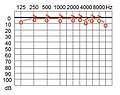
The hearing range is typically measured using an audiogram, which is a graph that shows the threshold of hearing relative to different frequencies. This test is conducted in a soundproof room using a device called an audiometer.
Hearing Range in Animals[edit]
Different species have different hearing ranges. For example, dogs can hear up to around 45 kHz, while elephants can hear sounds as low as 14 Hz. Bats, known for their use of echolocation, can detect frequencies up to 120 kHz.
Implications[edit]
Understanding the hearing range is important in various fields, including medicine, acoustics, and animal behavior. It has implications for the design of audio equipment, hearing protection, and noise regulation policies.
See Also[edit]

Hearing range[edit]
-
 Animal hearing frequency range
 -
 Hörfläche
 -
 Tonaud w norm
 -
 Cat ears
 -
 Pacific White Sided Dolphin


Ad. Transform your health with W8MD Weight Loss, Sleep & MedSpa

Tired of being overweight?
Special offer:
Budget GLP-1 weight loss medications
- Semaglutide starting from $29.99/week and up with insurance for visit of $59.99 and up per week self pay.
- Tirzepatide starting from $45.00/week and up (dose dependent) or $69.99/week and up self pay
✔ Same-week appointments, evenings & weekends
Learn more:
- GLP-1 weight loss clinic NYC
- W8MD's NYC medical weight loss
- W8MD Philadelphia GLP-1 shots
- Philadelphia GLP-1 injections
- Affordable GLP-1 shots NYC
|
WikiMD Medical Encyclopedia |
Medical Disclaimer: WikiMD is for informational purposes only and is not a substitute for professional medical advice. Content may be inaccurate or outdated and should not be used for diagnosis or treatment. Always consult your healthcare provider for medical decisions. Verify information with trusted sources such as CDC.gov and NIH.gov. By using this site, you agree that WikiMD is not liable for any outcomes related to its content. See full disclaimer.
Credits:Most images are courtesy of Wikimedia commons, and templates, categories Wikipedia, licensed under CC BY SA or similar.
Translate this page: - East Asian
中文,
日本,
한국어,
South Asian
हिन्दी,
தமிழ்,
తెలుగు,
Urdu,
ಕನ್ನಡ,
Southeast Asian
Indonesian,
Vietnamese,
Thai,
မြန်မာဘာသာ,
বাংলা
European
español,
Deutsch,
français,
Greek,
português do Brasil,
polski,
română,
русский,
Nederlands,
norsk,
svenska,
suomi,
Italian
Middle Eastern & African
عربى,
Turkish,
Persian,
Hebrew,
Afrikaans,
isiZulu,
Kiswahili,
Other
Bulgarian,
Hungarian,
Czech,
Swedish,
മലയാളം,
मराठी,
ਪੰਜਾਬੀ,
ગુજરાતી,
Portuguese,
Ukrainian
