Biophotonics
Biophotonics is an interdisciplinary field that involves the study and application of light (photons) in biological systems. Biophotonics is at the intersection of biology, physics, and engineering, and it focuses on the development and use of optical techniques to study biological molecules, cells, and tissues. It is a rapidly growing area with applications in medical diagnostics, therapy, and biomedical research.
Overview[edit]
Biophotonics utilizes various properties of light, including its intensity, polarization, phase, and wavelength, to probe and manipulate biological materials. The techniques developed in biophotonics allow for the non-invasive observation and analysis of biological processes in real time and at the molecular and cellular levels. This capability makes biophotonics a powerful tool in the field of life sciences and medicine.
Applications[edit]
The applications of biophotonics are vast and include, but are not limited to, the following areas:
- Medical Diagnostics: Techniques such as Optical Coherence Tomography (OCT) and Fluorescence Microscopy are used for early detection of diseases, including cancer and retinal diseases.
- Therapeutics: Light-based therapies, such as Photodynamic Therapy (PDT) and laser surgery, are used for treating various medical conditions, including cancer and eye disorders.
- Cellular and Molecular Imaging: Biophotonics provides tools for visualizing cellular structures and functions, facilitating the study of cellular processes, protein interactions, and DNA dynamics.
- Biosensing: The development of biosensors using biophotonic technologies enables the detection of pathogens, toxins, and biomarkers for various diseases.
Key Techniques[edit]
Several key techniques are central to the field of biophotonics, including:
- Fluorescence Spectroscopy: A technique that measures the fluorescence emitted by molecules upon light excitation, used for studying molecular interactions and dynamics.
- Raman Spectroscopy: A spectroscopic technique used to observe vibrational, rotational, and other low-frequency modes in a system, providing a molecular fingerprint for sample identification.
- Optical Coherence Tomography (OCT): A non-invasive imaging technique that provides high-resolution cross-sectional images of tissues, widely used in ophthalmology.
- Two-Photon Microscopy: A fluorescence imaging technique that allows for deep tissue imaging, used for studying biological processes in vivo.
Challenges and Future Directions[edit]
Despite its significant advancements, biophotonics faces several challenges, including the need for improved sensitivity and specificity in imaging and sensing, the development of compact and affordable devices for clinical and field use, and the integration of biophotonic devices with existing medical infrastructure. Future directions in biophotonics research include the development of novel light sources and detectors, the integration of artificial intelligence for data analysis, and the exploration of new applications in neuroscience, regenerative medicine, and global health.
See Also[edit]
References[edit]
<references/>

Biophotonics[edit]
-
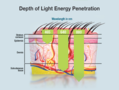 Light Penetration
 -
 Nanoparticles (yellow) targeting and entering cancer cells (blue)

_targeting_and_entering_cancer_cells_(blue).png)
Ad. Transform your health with W8MD Weight Loss, Sleep & MedSpa

Tired of being overweight?
Special offer:
Budget GLP-1 weight loss medications
- Semaglutide starting from $29.99/week and up with insurance for visit of $59.99 and up per week self pay.
- Tirzepatide starting from $45.00/week and up (dose dependent) or $69.99/week and up self pay
✔ Same-week appointments, evenings & weekends
Learn more:
- GLP-1 weight loss clinic NYC
- W8MD's NYC medical weight loss
- W8MD Philadelphia GLP-1 shots
- Philadelphia GLP-1 injections
- Affordable GLP-1 shots NYC
|
WikiMD Medical Encyclopedia |
Medical Disclaimer: WikiMD is for informational purposes only and is not a substitute for professional medical advice. Content may be inaccurate or outdated and should not be used for diagnosis or treatment. Always consult your healthcare provider for medical decisions. Verify information with trusted sources such as CDC.gov and NIH.gov. By using this site, you agree that WikiMD is not liable for any outcomes related to its content. See full disclaimer.
Credits:Most images are courtesy of Wikimedia commons, and templates, categories Wikipedia, licensed under CC BY SA or similar.
Translate this page: - East Asian
中文,
日本,
한국어,
South Asian
हिन्दी,
தமிழ்,
తెలుగు,
Urdu,
ಕನ್ನಡ,
Southeast Asian
Indonesian,
Vietnamese,
Thai,
မြန်မာဘာသာ,
বাংলা
European
español,
Deutsch,
français,
Greek,
português do Brasil,
polski,
română,
русский,
Nederlands,
norsk,
svenska,
suomi,
Italian
Middle Eastern & African
عربى,
Turkish,
Persian,
Hebrew,
Afrikaans,
isiZulu,
Kiswahili,
Other
Bulgarian,
Hungarian,
Czech,
Swedish,
മലയാളം,
मराठी,
ਪੰਜਾਬੀ,
ગુજરાતી,
Portuguese,
Ukrainian
