Bartolomeo Eustachi
Bartolomeo Eustachi (also known as Eustachius) (c. 1500/1514 – 27 August 1574) was an Italian anatomist and one of the pioneers of modern anatomy. He is best known for his discovery of the Eustachian tube, a canal that connects the middle ear to the nasopharynx, which bears his name.
Early Life and Education[edit]
Eustachi was born in San Severino Marche, in the Marche region of Italy, around the year 1500 or 1514. Little is known about his early life and education, but it is believed that he studied medicine at the University of Padua, one of the leading medical schools of the time.
Career[edit]
Eustachi served as a physician to the Duke of Urbino and later became a professor of anatomy at the University of Rome. He made significant contributions to the field of anatomy, including the discovery of the adrenal glands and the vena cava, and the first accurate description of the kidneys and teeth.
Eustachi's most famous discovery, the Eustachian tube, was first described in his work De auditus organis (On the Organs of Hearing), published in 1562. This discovery was significant as it helped to further the understanding of the anatomy and physiology of the ear and contributed to the development of treatments for ear diseases.
Legacy[edit]
Eustachi's work laid the foundation for future advancements in the field of anatomy. His detailed and accurate descriptions of the human body and its organs have been widely recognized and appreciated by the medical community. His name is immortalized in the Eustachian tube, reminding us of his significant contributions to the field of otolaryngology.
See Also[edit]
References[edit]
<references />

Bartolomeo Eustachi[edit]
-
 Bartolomeus Eustachius
 -
 Eustachi t21
 -
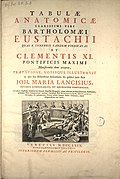 Eustachi - Tabulae anatomicae, 1769


Ad. Transform your life with W8MD's
GLP-1 weight loss injections special from $29.99 with insurance
|
WikiMD Medical Encyclopedia |
Medical Disclaimer: WikiMD is for informational purposes only and is not a substitute for professional medical advice. Content may be inaccurate or outdated and should not be used for diagnosis or treatment. Always consult your healthcare provider for medical decisions. Verify information with trusted sources such as CDC.gov and NIH.gov. By using this site, you agree that WikiMD is not liable for any outcomes related to its content. See full disclaimer.
Credits:Most images are courtesy of Wikimedia commons, and templates, categories Wikipedia, licensed under CC BY SA or similar.
Translate this page: - East Asian
中文,
日本,
한국어,
South Asian
हिन्दी,
தமிழ்,
తెలుగు,
Urdu,
ಕನ್ನಡ,
Southeast Asian
Indonesian,
Vietnamese,
Thai,
မြန်မာဘာသာ,
বাংলা
European
español,
Deutsch,
français,
Greek,
português do Brasil,
polski,
română,
русский,
Nederlands,
norsk,
svenska,
suomi,
Italian
Middle Eastern & African
عربى,
Turkish,
Persian,
Hebrew,
Afrikaans,
isiZulu,
Kiswahili,
Other
Bulgarian,
Hungarian,
Czech,
Swedish,
മലയാളം,
मराठी,
ਪੰਜਾਬੀ,
ગુજરાતી,
Portuguese,
Ukrainian
