Cube
Cube is a three-dimensional geometric shape that is characterized by its six equal square faces, twelve equal straight edges, and eight vertices. The cube is one of the five Platonic solids and is the only one among them that has all its faces square.
Properties[edit]
A cube has several interesting properties. For instance, it is both a prism and a hexahedron. It is also a regular square prism, an equilateral cuboid and a right rhombohedron. A cube is a regular quadrilateral and a square parallelepiped.
Dimensions[edit]
The length of the edge of a cube is often referred to as its 'side' or 'edge length'. The surface area of a cube can be calculated by multiplying the square of the edge length by six, while the volume can be calculated by cubing the edge length.
In Mathematics[edit]
In mathematics, the cube is often used as a teaching tool in geometry classes. It is also used in various mathematical problems and equations. For instance, the cube is used in the calculation of volume and surface area.
In Nature[edit]
Cubes are not commonly found in nature, but they can be seen in the form of crystals, such as salt crystals.
In Culture[edit]
Cubes have been used in various cultures for different purposes. For instance, they have been used in games, puzzles, and art. The Rubik's Cube is a popular example of a cube used in a puzzle game.
See Also[edit]
References[edit]
<references />
 | |
|---|---|
 |
 |
Cube[edit]
-
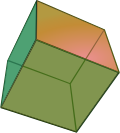 Hexahedron
 -
 Cube diagonals
 -
 Prince Rupert's cube
 -
 01-Würfelverdoppelung-4
 -
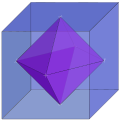 Dual Cube-Octahedron
 -
 Hexahedron
 -
 The 11 cubic nets
 -
 3-cube column graph
 -
 Hypercube construction
 -
 Kepler Hexahedron Earth
 -
 Mysterium Cosmographicum solar system model
 -
 Cube and Stell


Ad. Transform your life with W8MD's
GLP-1 weight loss injections special from $29.99 with insurance
|
WikiMD Medical Encyclopedia |
Medical Disclaimer: WikiMD is for informational purposes only and is not a substitute for professional medical advice. Content may be inaccurate or outdated and should not be used for diagnosis or treatment. Always consult your healthcare provider for medical decisions. Verify information with trusted sources such as CDC.gov and NIH.gov. By using this site, you agree that WikiMD is not liable for any outcomes related to its content. See full disclaimer.
Credits:Most images are courtesy of Wikimedia commons, and templates, categories Wikipedia, licensed under CC BY SA or similar.
Translate this page: - East Asian
中文,
日本,
한국어,
South Asian
हिन्दी,
தமிழ்,
తెలుగు,
Urdu,
ಕನ್ನಡ,
Southeast Asian
Indonesian,
Vietnamese,
Thai,
မြန်မာဘာသာ,
বাংলা
European
español,
Deutsch,
français,
Greek,
português do Brasil,
polski,
română,
русский,
Nederlands,
norsk,
svenska,
suomi,
Italian
Middle Eastern & African
عربى,
Turkish,
Persian,
Hebrew,
Afrikaans,
isiZulu,
Kiswahili,
Other
Bulgarian,
Hungarian,
Czech,
Swedish,
മലയാളം,
मराठी,
ਪੰਜਾਬੀ,
ગુજરાતી,
Portuguese,
Ukrainian
